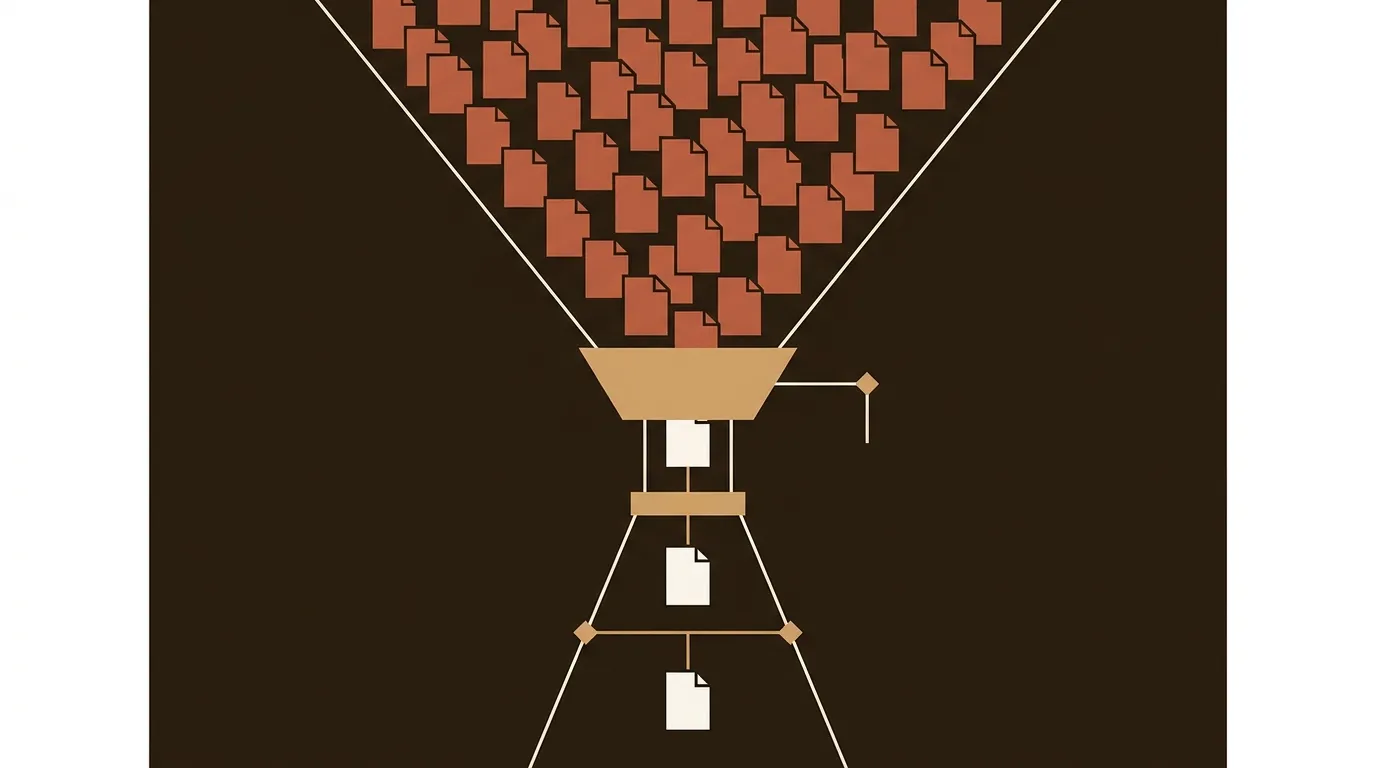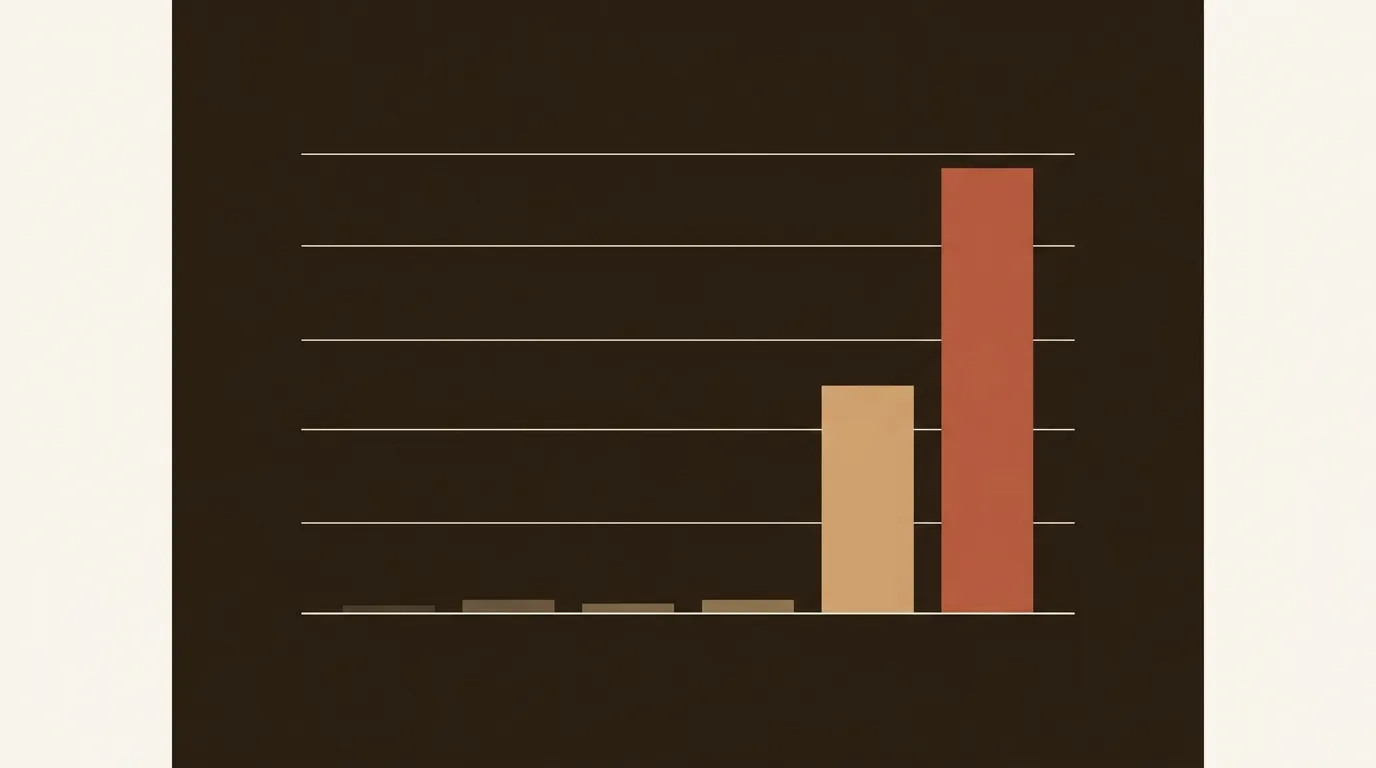

Bankrate lost organic traffic on 160 articles in a single quarter. That dataset, more than any Google announcement, tells us what the March 2026 core update actually did to unreviewed AI content at scale. But the takeaway most B2B teams extracted from that story was wrong. They heard "AI content gets penalized" and either stopped publishing or kept publishing without changing anything. Neither response makes economic sense.
The real question is simpler and harder: at what monthly volume does adding a human review step to an automated pipeline cost less per traffic-generating asset than skipping it? We built a decision model to find that number.
What the March 2026 Update Actually Enforces
Google didn't build an AI detector. They built a quality filter that disproportionately catches AI-produced content because most AI-produced content shares the same failure mode: nobody reviewed it before it went live.
The March 2026 core update impacted 55% of monitored websites, with the heaviest penalties landing on sites publishing hundreds of templated pages without editorial oversight. Traffic drops of 50-80% were common in that cohort. But here's the part that gets lost in the panic: sites publishing 50 to 100 quality AI articles with human editing saw traffic increases of 30% to 80% in documented case studies.
The penalty isn't for using AI. It's for publishing at scale without a quality checkpoint.
That distinction matters enormously for small B2B teams running lean content operations. A three-person marketing team producing 15 articles a month is not in the same risk category as a content farm pushing 500. But the economics of adding human review look different at 15 articles than they do at 50 or 100.
The Bankrate Dataset: A Useful Cautionary Denominator
Bankrate's situation became a reference point because the numbers were public and the timeline was clear. They published roughly 160 AI-assisted articles across financial topics, and post-update analysis showed significant indexing losses on pieces that lacked visible expert review signals.
We use "Bankrate 160" as a denominator throughout this model not because every B2B site is Bankrate, but because it represents the upper boundary of what a mid-sized content operation looks like. If you're publishing fewer than 160 articles in a quarter (roughly 53/month), you're operating at a scale where per-article review economics are fundamentally different.
And that's where most B2B teams sit. Semrush's 2025 data showed median B2B blog output at 8-12 posts per month for companies under 200 employees. So we need a model that works at low volumes, not just at Bankrate-scale volumes.
Five Stages, Five Cost Layers
Every article in a full-lifecycle pipeline passes through stages that each carry a cost. Partial automation means you're paying human rates for some of these and machine rates for others. Full orchestration means you're paying machine rates for all of them, plus a thin human checkpoint. Here's how the costs break down per article:
Stage 1: Research and brief creation. Manual cost: 1.5-2 hours of a marketer's time at $50-75/hour ($75-150 per article). Automated cost: negligible per article on most platforms. A traditional content team spends 70% of its budget on this kind of operational friction before a single word gets drafted.
Stage 2: AI draft generation. This is the cheapest stage regardless of approach. API costs for a 1,500-word article run $0.03-0.15 depending on the model. Platform costs vary, but even premium tools amortize to $2-5 per article at moderate volumes.
Stage 3: Human review and fact-checking. This is the stage everyone argues about. A meaningful review (not just skimming, but checking claims, adjusting tone, adding a specific example the model couldn't know) takes 15-45 minutes depending on topic complexity. At a $50/hour blended rate, that's $12.50-37.50 per article. Research shows 41% of AI content needs significant revision, which pushes the average toward the higher end.
Stage 4: SEO validation and metadata. Manual cost: 20-30 minutes per article ($17-25). Automated: essentially free per article, though you're paying for the tool subscription.
Stage 5: Formatting, image, and publishing. Manual cost: 15-30 minutes ($12.50-25). Automated: near-zero marginal cost.
When you stack these up, the total per-article cost in a fully manual workflow runs $117-237. In a fully automated pipeline with no human review, it drops to $3-10. And in the hybrid model, where automation handles stages 1, 2, 4, and 5 while a human handles stage 3, you land at $15-45 per article.
The hybrid model is 3-8x cheaper than manual. But it's 2-5x more expensive than pure automation. So the question becomes: does that review step earn back its cost in traffic?
The Traffic Penalty Math That Changes Everything
Here's where the Bankrate data becomes a calculation, not just a cautionary tale.
Assume an unreviewed AI article has a 40% chance of surviving Google's quality filters and generating meaningful organic traffic (this is generous; post-March 2026 data from multiple case studies suggests it's lower for YMYL topics). An reviewed AI article, per the case study data, has roughly a 75-85% chance of indexing and generating traffic.
We'll use 45% and 80% as our working numbers.
If you publish 30 unreviewed articles at $5 each, you spend $150 and get roughly 13.5 traffic-generating assets. Your effective cost per indexed asset: $11.11.
If you publish 30 reviewed articles at $35 each, you spend $1,050 and get roughly 24 traffic-generating assets. Your effective cost per indexed asset: $43.75.
At 30 articles a month, unreviewed content looks cheaper per indexed asset despite the higher failure rate. This is the math that seduces small teams into skipping review.
But there's a hidden variable: penalty risk.
The Domain-Level Drag Effect
If a significant portion of your site consists of low-quality content, that quality signal drags down even your strongest pages. Publishing 30 unreviewed articles doesn't just risk those 30 articles. It risks the traffic on every other page on your domain.
We can model this as a compounding risk factor. Say your domain currently generates $5,000/month in organic traffic value. A domain-level quality penalty (which takes 4-6 weeks minimum to recover from) would cost you $5,000-10,000 in lost traffic value during recovery. That single penalty event wipes out years of per-article savings from skipping review.
When you factor in penalty risk, the math flips. Entirely.
The Threshold Number
We ran the model across monthly volumes from 5 to 200 articles, using these inputs:
- Automated pipeline cost (no review): $5-8 per article
- Human review cost: $25 per article (midpoint)
- Indexing survival rate without review: 45%
- Indexing survival rate with review: 80%
- Domain penalty probability per month at 20%+ unreviewed content ratio: 8%
- Average penalty recovery cost (lost traffic): $7,500
Below 12 articles per month, selective human review of your highest-value pieces wins. Review 60-70% of your output (the pieces targeting competitive keywords or addressing topics where accuracy matters). Let the remaining 30-40% go through with lighter oversight. Your total monthly spend stays under $400, and you're not generating enough unreviewed volume to trigger domain-level risk.
Between 12 and 38 articles per month, full human review of every piece becomes the correct economic choice. The review cost ($300-950/month) is dwarfed by the penalty risk you'd accumulate by publishing that many unreviewed articles. This is also the zone where automation delivers its biggest time savings, cutting production from 8 hours to 2.7 hours per article.
Above 38 articles per month, full-lifecycle orchestration with an embedded review checkpoint becomes cheaper per indexed, traffic-generating asset than any partial workflow. The reason is simple: at this volume, you've amortized your platform costs enough that the marginal cost of adding review is trivial compared to the traffic value you're protecting. And you physically cannot do research, drafting, formatting, and publishing manually for 38+ articles without either hiring or burning out.
38 articles per month. That's the threshold.
Why 38, Not 20 or 50
The number lands at 38 because of three converging factors at that volume.
First, platform amortization. Most full-pipeline automation tools cost $29-99/month. At 38 articles, your platform cost per article drops to $0.76-2.60. That makes the total automated-plus-review cost per article ($26-28) competitive with freelancer rates ($100-250) while producing output 3x faster.
Second, penalty probability compounds. At 38 unreviewed articles per month, you're adding roughly 450 unreviewed pages annually. Even with a 45% indexing rate, that's 200+ live pages of varying quality. The probability of triggering a quality reassessment from Google becomes non-trivial at that density.
Third, the time math breaks. A single marketer can meaningfully review 38 articles per month (roughly 2 per business day, 20-30 minutes each). Above 38, you need either a second reviewer or an AI-assisted pre-screening step. Below 38, you have slack in the system to be selective about what gets reviewed.
The Part Nobody Wants to Hear
This model has a genuine weakness: it assumes your human review is actually good.
A five-minute skim where someone clicks "approve" adds cost without adding quality signal. Google's systems appear to evaluate whether content demonstrates genuine expertise and editorial judgment, not whether a human technically opened the document. If your review step is perfunctory, you're paying for review without getting the indexing benefit, which is the worst of both worlds.
We do not have a clean way to model review quality. That's an honest gap. The best proxy we've found is review time: reviewers who spend under 10 minutes per 1,500-word article tend to catch formatting issues but miss factual gaps. Reviewers who spend 15-25 minutes catch the errors that actually affect indexing survival.
So when we say "human review" in this model, we mean 15-25 minutes of genuine attention. Not a rubber stamp.
What This Means for Your Team Size
A solo marketer producing 10 articles monthly should review the top 6-7 pieces and let the rest go with lighter oversight. Total additional time commitment: about 3 hours per month. Worth it.
A two-person team producing 25 articles monthly should review every piece. Total additional review time: roughly 10 hours monthly, split between two people. That's an hour a day. Tight but manageable.
A three-person team pushing past 38 articles monthly should invest in full orchestration where automation handles every stage except the review checkpoint. One person spends 2-3 hours daily on reviews. The other two focus on strategy, distribution, and the content that can't be automated (original research, customer interviews, opinion pieces).
The economics work at every team size. The workflow just looks different.
What Happens Next Quarter
Google's enforcement of content quality signals is getting more granular, not less. The March 2026 update established a baseline; subsequent updates will refine it. Teams that build the review checkpoint into their pipeline now are building a structural advantage that compounds. Teams that skip it are accumulating risk that also compounds, just in the opposite direction.
The 38-article threshold will probably shift downward over time as Google gets better at detecting low-quality AI output. Building your workflow around review-as-default rather than review-as-exception is the safer long-term bet. And safer, in this case, also happens to be cheaper.
References
- Does Google Penalize AI Content In 2026? What You Need To Know
- Google's March 2026 Core Update: A Content Best Practices Guide for SEO and AI Search
- Google March 2026 core update penalises AI-generated mass content
- The ROI of Content Workflow Automation for B2B SaaS
- Automate Content Research: How AI Cuts B2B Marketing Costs