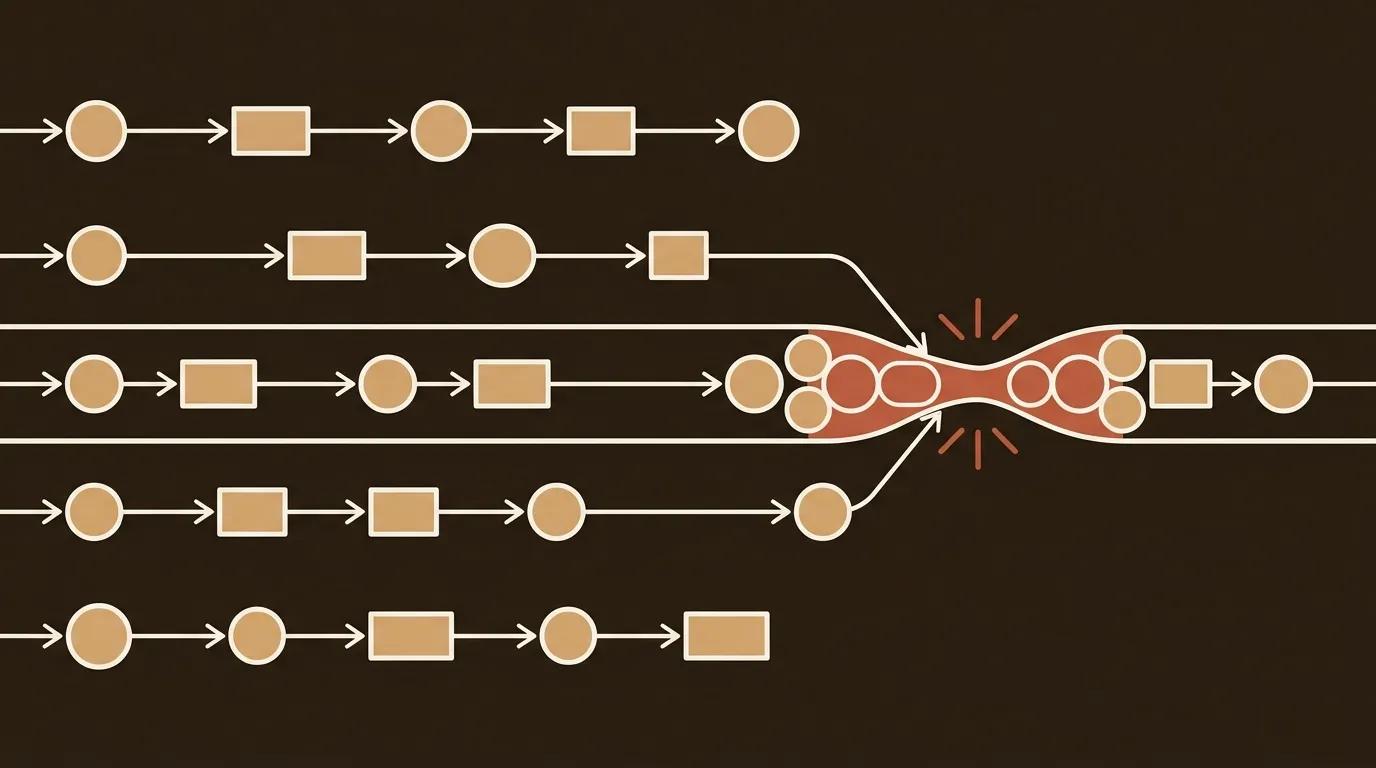

85% of B2B marketing teams now use AI tools in some capacity. But only 19% have integrated AI into their daily workflows, according to G2's 2026 analysis of AI in B2B marketing. That's a 66-percentage-point gap between "we bought the tool" and "the tool actually changed how we work."
We've spent the last two years watching this gap widen. And the competitive difference it creates isn't subtle. It shows up in cost per article, publishing cadence, organic traffic per post, and time-to-rank. The teams pulling ahead aren't the ones with better writers or bigger budgets. They're the ones who automated beyond the draft.
This post lays out a maturity scorecard for B2B content operations, maps the cost of each automation gap, and identifies which single fix returns the most within 90 days.
The Three Tiers of Content Automation Maturity
54% of B2B marketing teams take an ad hoc approach to AI. They've signed up for ChatGPT, maybe Jasper, possibly a keyword tool. Each one runs independently. The human is the integration layer, copying outputs between tabs.
Another 27% have connected a few tools. Generation feeds into a CMS. Maybe keyword research informs briefs semi-automatically. But QA is still manual, distribution is still a checklist, and performance data never loops back into strategy.
The remaining 19% run integrated workflows that span research, generation, quality evaluation, SEO optimization, and distribution with feedback loops that adjust future content based on what's actually ranking.
We call these Tier 1, Tier 2, and Tier 3. The difference between them isn't sophistication of the AI models. It's plumbing.
Gartner forecasts that 40% of enterprise applications will embed task-specific AI agents by 2026, up from less than 5% in 2025. That trajectory tells you where this is heading. But right now, most teams are stuck at Tier 1, paying for five tools and getting the output of one.
What Each Tier Actually Costs
Let's do the math on a 2-person content team publishing 12 articles per month.
Tier 1 (Ad Hoc): The team uses separate tools for research, writing, SEO, and scheduling. Each tool runs $50 to $400/month. Total tool spend sits around $500 to $1,500/month. But here's the hidden cost: manual handoff between systems eats 8 to 12 hours per month. At a blended rate of $75/hour, that's $600 to $900 in invisible labor. Factor in the 15 hours per article for production (research, drafting, editing, formatting, publishing), and each article costs roughly $1,125 before distribution. Twelve articles per month: $13,500 in labor alone.
Tier 2 (Partial Stack): Some automation kicks in. AI handles first drafts, cutting generation time by 30 to 40%. A basic Zapier chain connects the CMS to social scheduling. Cost per article drops to around $700 to $800. But the team still manually reviews every piece for brand voice, still hand-optimizes meta descriptions, and still checks for factual accuracy by reading each draft line by line. The bottleneck has shifted from writing to everything around writing.
Tier 3 (Full Stack): Research, generation, evaluation, SEO, and publishing run as a connected pipeline. AI-generated content at this level reduces production costs by up to 40% while increasing output volume by 3x. Cost per article: $300 to $450. The same 2-person team that was producing 12 articles at $13,500/month can now produce 30 to 40 articles at $9,000 to $13,500. Cost per article drops. Volume goes up. And here's the part that gets overlooked: consistency goes up too, because the pipeline enforces quality standards that humans forget under deadline pressure.
The Yield Gap Is Bigger Than the Cost Gap
Cost savings are nice. But the organic traffic difference between tiers is where the real math gets interesting.
Research Automation Alone Changes Rankings
AI can analyze hundreds of top-ranking pages in minutes, identify content gaps, extract statistics, and compile competitor positioning faster than any human analyst. We've seen teams cut research time from three hours per article to under ten minutes. That's not an efficiency gain. That's a category change.
More importantly, automated research produces more thorough briefs. A human researcher skimming ten SERPs will miss patterns that surface only across fifty. The articles built on AI-analyzed briefs tend to cover more subtopics, include more relevant entities, and answer more "People Also Ask" questions. All of which correlate with higher rankings.
QA Integration Prevents the Slow Bleed
Here's a pattern we see repeatedly: a team automates drafting, publishes faster, celebrates the output increase, then watches average ranking position drift downward over three months. The problem isn't the AI writing. It's the absence of an evaluation layer between generation and publishing.
The most effective approach in 2026 combines AI drafting with expert editorial oversight and structured answer engine optimization. Teams that skip the QA step (or do it inconsistently because a human is tired on Friday afternoon) accumulate small quality deficits that compound over time. Google's December 2025 core update made this painfully clear: content without genuine expertise signals faces ranking penalties.
An automated QA layer doesn't replace human judgment. It catches the 80% of issues that are mechanical: thin sections, missing internal links, keyword stuffing, duplicate angles across your own blog. The human editor then focuses on the 20% that requires actual expertise.
Distribution Is the Most Neglected Multiplier
68% of content teams report distribution as their biggest bottleneck. And yet most AI content discussions focus exclusively on generation. This is like optimizing a factory's assembly line while leaving finished products on the loading dock.
Distribution automation, connecting your CMS to social channels, email sequences, syndication platforms, and internal linking systems, showed 156% year-over-year adoption growth in 2025. Teams that automate distribution see each article reach 2 to 4x more initial touchpoints, which accelerates the crawl-index-rank cycle for SEO and generates social signals that correlate with faster authority building.
The Diagnostic: Writing Problem, Workflow Problem, or Integration Problem?
Most teams misdiagnose themselves. A team convinced they have a "writing quality problem" often has a workflow problem. A team buying more tools to fix speed usually has an integration problem. Here's how to tell.
Signs You Have a Writing Problem
Your drafts require heavy editing for tone, accuracy, or structure. Brand voice is inconsistent across articles. Pieces pass internal review on some days and fail on others with no clear pattern. The fix here is specific: implement brand voice templates, add structured editorial guidelines that the AI can follow, and create a review rubric so "quality" isn't subjective. Expected 90-day efficiency gain: 15 to 20%.
Signs You Have a Workflow Problem
Your tools are good. Your people are capable. But articles take three weeks from brief to published. The bottleneck moves around, sometimes it's the brief, sometimes it's design, sometimes it's the editor's calendar. Copy-pasting between systems is normal. Meeting time exceeds production time. The fix: map the handoff points, automate the transitions (not the tasks), and consolidate dashboards. You probably don't need another tool. You need the ones you have to talk to each other. Expected 90-day efficiency gain: 25 to 35%.
Signs You Have an Integration Problem
Your CMS doesn't connect to your analytics platform. Performance data from published content never informs future content decisions. Your keyword research tool outputs a spreadsheet that someone manually reformats into a brief template. You have no feedback loop. This is the most expensive problem to leave unsolved, because every article you publish teaches you nothing about the next one. The fix: budget 20% of tool costs for integration and training. Use native APIs where available, Zapier or Make for the gaps, and a unified platform (HubSpot, Webflow with integrations) if starting fresh. Expected 90-day efficiency gain: 35 to 50%, plus visibility into what's actually working.
The 90-Day Sequence That Returns the Most
We've watched dozens of small B2B teams attempt this transition. The ones that succeed follow a specific order.
Weeks 1 to 2: Run a diagnostic audit. Map every tool, every handoff, every manual step. Calculate the hourly cost of each. Identify the single biggest bottleneck. Do not skip this step. Teams that jump straight to buying tools end up back at Tier 1 with a bigger bill.
Weeks 3 to 6: Fix one layer. Just one. If distribution is the bottleneck, connect your CMS to your channels. If QA is the bottleneck, implement an automated editorial checklist with human review gates. If research is slow, automate competitive analysis and keyword clustering. Organizations typically see 40 to 60% reductions in content creation costs within the first year, but the first visible gains arrive in weeks, not months.
Weeks 7 to 12: Measure the impact of the first fix, then add the next layer. Resist the urge to automate everything at once. Each layer needs calibration. A QA system trained on your brand voice needs two to three weeks of human feedback before it's reliable. A distribution automation needs testing across channels before you trust it with every post.
The 12-Month Window
The AI agents market is expected to grow at a 45.8% CAGR through 2030. That growth rate means the gap between Tier 1 and Tier 3 teams will close eventually. Every CMS will embed AI agents. Every SEO tool will auto-optimize. Every distribution platform will have one-click syndication.
But "eventually" is 2028 or 2029. Right now, in mid-2025, the structural advantage belongs to teams that have connected their stack. And in content marketing, structural advantages compound. A team publishing 40 optimized articles per month for 18 months builds a content moat that's genuinely hard to replicate, even after the tools become commodity.
The question worth asking internally isn't "should we use AI for content?" That ship sailed. It's "which of our three problems, writing, workflow, or integration, is costing us the most per article, and what does it take to fix that one thing in the next 90 days?"
Sometimes the answer is surprisingly cheap. Sometimes it's genuinely messy and the ROI timeline is uncertain. Either way, knowing which problem you're solving is the part most teams skip. And it's the part that determines whether the next tool you buy actually changes anything.