
Sixty-eight percent of Google searches in the first four months of 2026 ended without a single click to any website, according to new data from SparkToro and Datos. That's up from 60% just two years ago. And yet, we keep talking to B2B marketing leads who are planning their 2026 content budgets as if every article they publish will earn its keep through traditional organic clicks.
It won't. The economics have moved. But they've moved in a direction that actually favors small teams willing to do the math, not the ones with the biggest budgets.
The Traffic Paradox Nobody's Pricing In
The instinct is to read the zero-click headline and panic. Fewer clicks means less traffic, less traffic means fewer leads, and fewer leads means content marketing is dead. We've heard some version of this from every marketing manager who's stared at a flattening GA4 curve this year.
But the second data point matters more than the first. Research from Opollo across 312 B2B firms found that AI referral traffic converts at 14.2%, compared to 2.8% for traditional Google organic. That's a 5x premium. Other studies show the gap is even wider in specific verticals; Ahrefs reported a 23x conversion lift from their own AI referral traffic.
So the real question isn't "how do we get our clicks back?" It's "what's each click actually worth now, and are we spending money to earn the right kind?"
A Dollar-for-Dollar Model: Volume Strategy vs. Citation Strategy
We built a simple model for a B2B SaaS team spending $3,000/month on content. That's roughly one full-time contractor or a small agency retainer. Nothing extravagant. It's the budget range where allocation decisions actually make or break pipeline targets.
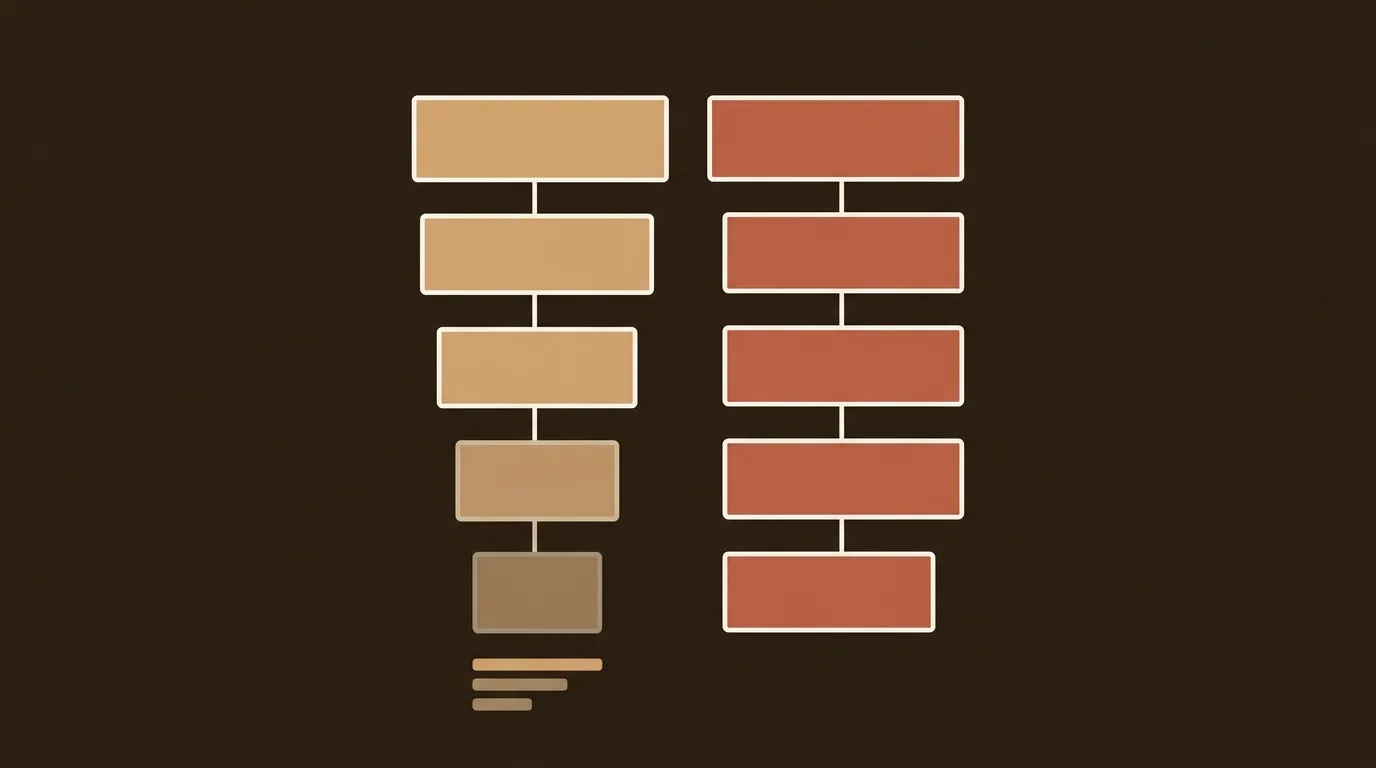
Scenario A: All-In on Traditional SEO
You spend the full $3,000 producing 6 well-researched articles per month optimized for Google rankings. Half the budget goes to writing, a third to promotion and link building, and the rest to technical SEO maintenance. Pretty standard playbook.
Realistic timeline: articles start ranking in positions 3-5 after 60-90 days. At month 6, you're pulling roughly 180 clicks per month from those early pieces. With a 2.5% conversion rate (generous for B2B), that's 4.5 conversions per month. Not bad, but not exactly transformative for a team trying to build predictable pipeline.
Scenario B: 60/40 Citation-First Split
You allocate $1,800 (60%) to citation-optimized content and structured generative engine optimization (GEO). The remaining $1,200 (40%) goes to traditional ranking content. You produce 4 citation-ready pieces and 2 traditional SEO articles per month.
Citation-optimized content gets structured differently. Entity clarity, direct answer formatting, source-ready data, and the kind of authoritative framing that AI engines prefer to cite. MarGen's data shows a median of 34 days from a structured GEO program launch to first measurable AI citation.
At month 6, you're generating perhaps 40-50 AI-referred clicks alongside 80-90 organic clicks. The total traffic is lower. But 40 clicks at a 12% conversion rate yields 4.8 conversions from AI referrals alone. Add the 2 conversions from organic, and you're at 6.8 total. That's 51% more pipeline from 30% less total traffic.
This is the math that changes budget conversations.
What Happens at Month 12 and Month 18
The gap widens. And that's the part most teams underestimate, because citation authority compounds differently than ranking authority.
Month 12
Your citation-focused content has been accumulating for nearly a year. Data-Mania's 2026 benchmarks show that top-quartile B2B SaaS sites earn 31 citations per month across major AI platforms, while bottom-quartile sites scrape by with 3.7. That's an 8.4x gap. By month 12, a team that started early sits comfortably in the second quartile and climbing.
We modeled this out. At month 12, the citation-first team generates approximately 120 AI-referred visits per month (citations compound as AI engines learn to trust a domain) and 150 organic visits from their smaller traditional SEO allocation. With conversion rates holding at 12% and 2.5% respectively, that's 14.4 + 3.75 = 18.15 conversions per month.
The all-traditional team? They've built more ranking momentum. Call it 400 organic visits per month by now, which is optimistic for 6 articles/month in a competitive B2B niche. At 2.5%, that's 10 conversions per month.
The citation-first team is generating 82% more pipeline. From roughly the same spend.
Month 18
This is where the model gets genuinely interesting. MarGen reports that brands with established AI citation authority show 41% lower customer acquisition costs and 2.3x higher 12-month lifetime value compared to paid-acquisition peers. The LTV lift makes sense: AI-referred buyers arrive having already consumed a synthesized comparison of their options. They're not browsing. They're shortlisting.
By month 18, the citation-first team has a library of content that feeds both surfaces. Many of their citation-optimized pieces also rank in Google's top 10 (because the structural qualities that earn citations overlap heavily with ranking signals). So they're not sacrificing organic presence; they're layering citation revenue on top.
We estimate 200+ AI-referred visits and 250+ organic visits per month. Pipeline contribution: 24 + 6.25 = 30.25 conversions per month.
The traditional-only team, by comparison, sits at roughly 600 organic visits and 15 conversions. Respectable, but the gap is now 2x.
Why the Conversion Premium Is Structural, Not a Fluke
Some of you are reading those conversion numbers and thinking they're inflated. Fair. We were skeptical too. But the mechanism behind the premium holds up to scrutiny.
When someone asks ChatGPT or Perplexity "what's the best project management tool for a 15-person remote team," the AI synthesizes dozens of sources and presents a curated answer. The user who then clicks through to your site has already passed the awareness and consideration stages. They're comparing shortlisted options or looking for specific pricing details. Adobe found that AI-referred shoppers spend 48% more time on product pages and view 13% more pages per session.
That behavioral pattern is fundamentally different from someone clicking a Google result for "project management software." The Google searcher might be writing a listicle. Might be a student researching the market. Might bounce in 8 seconds. The AI-referred visitor already knows why they're there.
This isn't a temporary anomaly. It's a function of how AI search works. The intermediary does the filtering, and only sends the most qualified traffic through.
The Allocation Threshold: A Simple Decision Framework
We're not going to pretend there's one magic ratio that works for every B2B team. But we can offer a concrete starting framework for teams spending under $3,000/month.
Start at 60/40 (citation-optimized / traditional SEO). Run it for 6 months. Track two things: citation volume (use tools like Otterly, Peec AI, or manual spot checks on ChatGPT and Perplexity) and conversion rate by traffic source.
At month 6, check this specific signal: if AI citation referral represents more than 5% of your monthly traffic but accounts for more than 20% of your conversions, shift to 70/30. That's the inflection point where your per-dollar return on citation content meaningfully exceeds traditional SEO content.
If you're not hitting that signal by month 6, don't panic. Some verticals take longer for AI engines to start citing consistently. Hold at 60/40 and reassess at month 9.
And here's the competitive angle that matters: only 48% of B2B SaaS companies currently track AEO citation performance as a KPI, up from just 11% in early 2025. More than half your competitors aren't even measuring this yet. That window won't stay open forever.
What This Means for Your Next Editorial Calendar
Stop thinking about content as a traffic acquisition mechanism and start thinking about it as a citation acquisition mechanism that also happens to rank. The shift is subtle in execution but dramatic in economics.
A piece of content optimized for citation needs different structural choices than one optimized purely for ranking. Entity-rich introductions. Direct, quotable answers to specific questions within the first 200 words. Named data points with clear sourcing. These are the patterns that AI engines select for citation, and they also happen to perform well in Google's AI Overviews.
We've seen teams make this transition without changing their total publishing volume or budget. They changed how they structured content, not how much they produced. The ROI shift showed up within one quarter.
One thing we'll be honest about: measuring attribution for AI citations is still genuinely messy. UTM parameters don't work the same way. Referral headers from ChatGPT and Perplexity are inconsistent. Some teams are reduced to correlating citation appearances with conversion spikes, which is imprecise. The measurement tooling will catch up, but right now it requires more manual tracking than most small teams want to do.
That said, imprecise measurement of a 5x conversion premium still beats precise measurement of a declining click-through rate. The teams that wait for perfect attribution data before reallocating budget will find themselves 18 months behind the ones that moved on directional evidence.
The math works. The competitive window is still open. And the teams that reweight their next content dollar toward citation visibility will compound an advantage that gets harder to catch with each passing quarter.
References
- Google zero-click searches reach 68% in early 2026: Study
- AI Referral Traffic vs Organic Search: Conversion Rates and Performance Compared
- In 2026, Less than One Third of Google Searches Still Send a Click, SparkToro
- AI Search Visibility Benchmarks 2026: Citation Rates & Share of Voice for B2B SaaS
- AI Citation Conversion Statistics: How AI-Cited Brands Convert Better