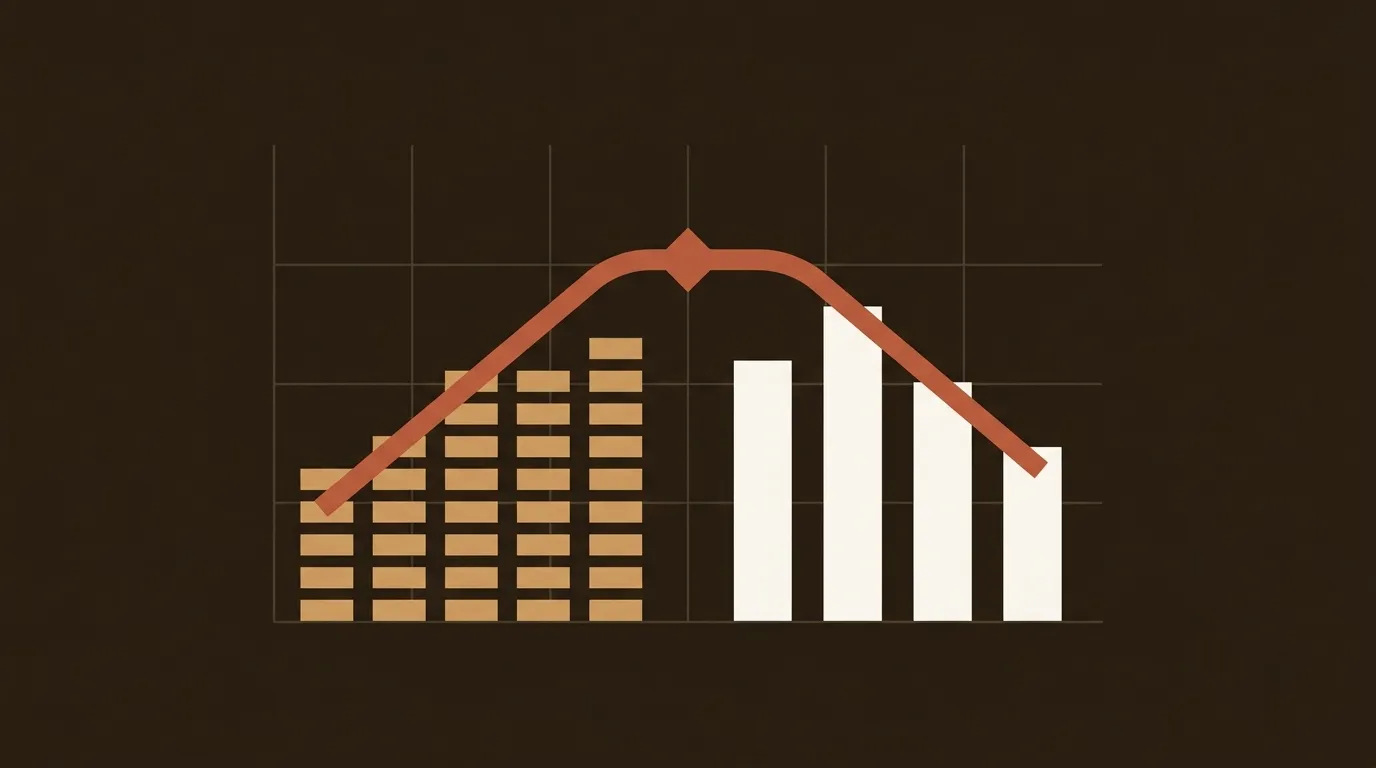

Fifty-five percent of tracked sites registered measurable ranking changes within two weeks of Google's March 2026 core update rolling out on March 6. That's not a gentle nudge. That's a reset of how topical authority gets scored, and it hit B2B sites especially hard because most of them were already doing the wrong thing: publishing scattered content across too many topics at shallow depth.
We've spent the last three months modeling what this update actually means for two-person content teams with constrained budgets. The finding that keeps showing up is uncomfortable for anyone who's built their editorial calendar around "more posts = more traffic." It's wrong now. Not slightly wrong. Structurally wrong.
The Variable Nobody Was Tracking
Most B2B content teams track publishing frequency. Some track keyword difficulty and search volume per post. Almost none track what we're calling cluster velocity: the elapsed time between a cluster's first published post and the point where its supporting content is complete enough to trigger compounding rankings.
Google's March 2026 update re-weighted quality signals around three properties: information originality, author expertise, and topical coherence. That third one, topical coherence, is the one that changed the math. It measures whether a domain has earned consistent authority within a defined subject area over time, rather than opportunistically publishing across many topics at shallow depth.
This means a site with 15 tightly interlinked posts covering "B2B email deliverability" from every angle will outrank a site with 40 posts scattered across email, social media, paid ads, and event marketing. Even if the 40-post site has higher domain authority. Even if it's been around longer.
The implication for editorial planning is specific: the gap between your pillar page going live and your last cluster page going live is now a ranking factor in practice, whether or not Google calls it that explicitly.
Two Strategies, Same Budget, Different Outcomes
We modeled two hypothetical two-person B2B teams. Both have an all-in content budget of $4,500/month (covering writer time, editing, SEO tools, and publishing). Both target the same broad niche: procurement software for mid-market companies.
Team A: Frequency-first. Publishes 8 posts per month across 4 different topic clusters. Each cluster gets 2 posts per month. At this rate, a 6-post cluster takes 3 months to complete.
Team B: Cluster-velocity-first. Publishes 6 posts per month but concentrates them into 1-2 clusters at a time. Each cluster gets 3-6 posts per month. A 6-post cluster completes in 1-2 months.
Same total budget. Team B publishes 25% fewer posts. And here's where it gets interesting.
Month 3 Snapshot
Team A has 24 posts live across 4 clusters. None of those clusters are complete. Google sees four half-built topic structures with weak internal linking density. Organic sessions from these posts: approximately 1,200/month, driven mostly by long-tail queries where competition is thin.
Team B has 18 posts live across 2 completed clusters and 1 cluster in progress. The two completed clusters have full bidirectional internal linking, pillar pages with 3,000+ words, and 4-5 supporting pages each. Organic sessions: approximately 1,800/month. The completed clusters are already ranking for mid-difficulty terms because topical completeness signals compound once Google indexes the full structure.
That's a 50% traffic advantage at month 3 with 25% fewer posts published.
Month 6: The Gap Widens
Team A now has 48 posts across 4 clusters. Two clusters are finally complete (at 12 posts each, which is over-built because posts were added without a completion plan). The other two clusters have 12 posts each but still lack pillar pages and coherent internal linking. Organic sessions: roughly 4,500/month.
Team B has 36 posts across 4 completed clusters and 1 new cluster in progress. Every completed cluster is generating compounding traffic. Organic sessions: roughly 7,200/month.
The dollar math at month 6: Team A spent $27,000 to generate 4,500 monthly sessions ($6.00 per session on a monthly basis). Team B spent $27,000 to generate 7,200 monthly sessions ($3.75 per session). That's a 37.5% lower cost-per-session for the slower publisher.
Month 12: Compounding Becomes Obvious
Team A has 96 posts across 8 clusters, with 5 complete and 3 half-built. Organic sessions: approximately 14,000/month. Cost per monthly session: $3.86.
Team B has 72 posts across 8 completed clusters. All clusters are generating mature compounding traffic with multiple pages ranking simultaneously for related long-tail queries. Organic sessions: approximately 22,000/month. Cost per monthly session: $2.45.
Same budget. 24 fewer posts. 57% more traffic at the 12-month mark.
Why 30% Is the Reallocation Number
We didn't pull "reduce new-topic output by 30%" from thin air. It comes from modeling where the breakeven sits.
If Team B reduced output by less than 20%, the cluster velocity advantage wasn't large enough to overcome the raw volume gap. The clusters completed only marginally faster, and the compounding effect didn't kick in early enough to matter within two quarters.
If Team B reduced output by more than 40%, total content production dropped too low to build new clusters at a reasonable pace. You end up with 2-3 very strong clusters and nothing else, which limits your keyword footprint.
30% is the sweet spot for a two-person team spending $3,000-$6,000/month on content. At that reduction, you're publishing roughly 6 posts instead of 8-9, but you're completing clusters in 4-6 weeks instead of 10-14 weeks. The compounding traffic from completed clusters more than compensates for the slower new-topic expansion.
This aligns with what Aspiration Marketing found in their 2026 analysis: 83% of marketers agree that publishing high-quality content less often outperforms flooding channels with average material. But the specific mechanism matters. It's not just "quality over quantity" as a vague mantra. It's that cluster completion speed determines when compounding starts.
The Post-Sequencing Threshold
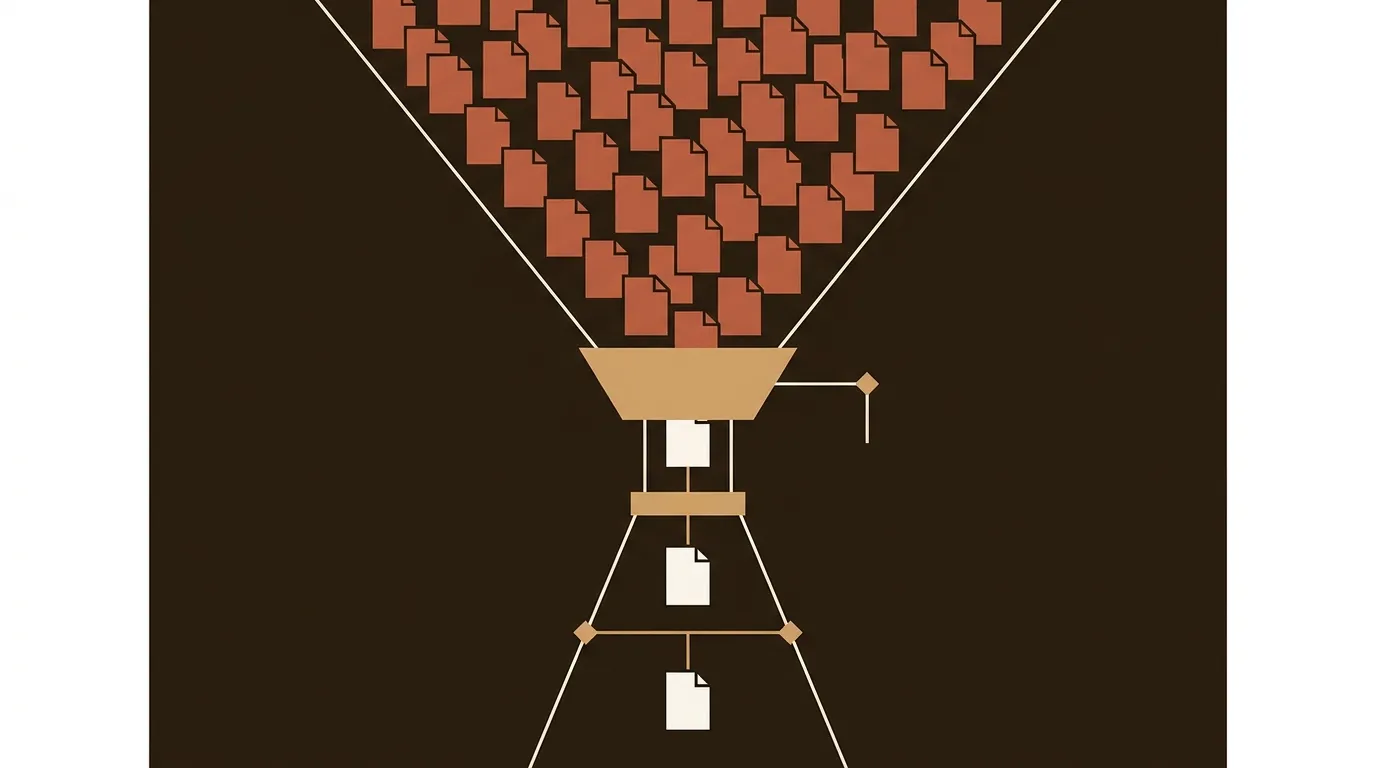
There's a specific threshold where cluster velocity overtakes frequency as the dominant traffic driver. We've been calling it the "cluster gap threshold," and for most B2B niches, it sits at roughly 6 weeks.
If the gap between your pillar page publishing and your last supporting cluster page publishing is under 6 weeks, you trigger compounding within the same Google indexing and re-ranking cycle. Your cluster pages start reinforcing each other before any individual page has time to plateau.
If the gap exceeds 6 weeks, each page in the cluster goes through its initial ranking cycle independently. It ranks, plateaus, and sometimes drops before the supporting content arrives to reinforce it. You're essentially paying the "ranking tax" on every post individually instead of getting the group discount.
For sites hit hard by the March 2026 update, recovery requires having substantive editorial improvements in place before the next major core update, expected June/July 2026. That gives teams roughly 10-12 weeks. Not enough time to publish 40 new posts, but plenty of time to complete 2-3 unfinished clusters with 4-6 targeted additions.
What a Cluster-Velocity Calendar Actually Looks Like
We're not going to pretend this is easy to implement. Shifting from a frequency-first calendar to a cluster-velocity calendar requires your team to do something psychologically difficult: stop starting new topics when the current one isn't finished.
For a two-person team publishing 6 posts per month, a cluster-velocity calendar looks something like this in practice. Weeks 1-2: publish pillar page (3,000-5,000 words) and first two supporting pages for Cluster A. Weeks 3-4: publish remaining 3 supporting pages for Cluster A, plus begin research for Cluster B's pillar. Then the next month, Cluster B gets the same concentrated treatment.
The pillar page needs to address the full topic at a high level and link to every cluster page. Bidirectional linking, pillar to cluster and cluster to pillar, distributes PageRank and reinforces topical signals for crawlers. This is non-negotiable. Half-linked clusters perform barely better than disconnected posts.
The hard part isn't the writing. It's the discipline of saying "no, we're not writing about that new trending topic until we finish this cluster." Two-person teams are especially susceptible to shiny-topic syndrome because the person choosing what to write and the person writing it are often the same person.
The Part That's Genuinely Messy
We should be honest about what this model doesn't resolve cleanly.
Cluster velocity optimization assumes you've correctly identified the right clusters to build. If you spend 6 weeks completing a cluster around a topic with insufficient search demand or no commercial intent, you've wasted a month and a half of concentrated effort instead of wasting it gradually across scattered posts. The damage is more concentrated too.
There's also a tension between cluster velocity and content freshness. Some B2B niches (cybersecurity, AI tooling, compliance) move fast enough that a 6-week-old pillar page needs updating before the cluster is even complete. We don't have a clean answer for that. The best workaround we've seen is timestamping pillar pages with a "last reviewed" date and scheduling quick update passes every 4 weeks, but it's messy.
And the 30% reallocation number assumes your team's per-post cost stays constant. If concentrating on fewer, deeper posts increases your per-post cost (because each one requires more research, more expert input, more internal review), the math shifts. We've seen per-post costs increase by 10-15% under a cluster-velocity model, which is fine because the traffic ROI still wins by a wide margin. But it's not the "free lunch" some content strategists imply when they say "just publish less."
What the Numbers Point Toward
High-quality, relevant content generates 9.5 times more leads than low-quality, non-targeted content. That stat has been floating around for a while, but post-March 2026, the mechanism behind it is clearer. It's not that "good content" magically attracts leads. It's that topically complete clusters rank for dozens of related long-tail queries simultaneously, which means your surface area for capturing intent-driven traffic expands geometrically instead of linearly.
A two-person team publishing 6 cluster-sequenced posts per month will outperform a two-person team publishing 9 scattered posts per month within two quarters. The dollar difference at month 12 in our model was $2.45 versus $3.86 per organic session, a 36.5% efficiency gap on identical budgets.
The next Google core update is expected sometime in June or July 2026. If your clusters aren't complete by then, you're leaving compounding traffic on the table for another quarter. Six weeks is enough time to close 2-3 cluster gaps with focused execution. Whether your team can maintain that focus, honestly, is the harder question.
References
- Google March 2026 Core Update: 10 Things You Need to Know , Pepper Content
- Google's March 2026 Core Update: A Content Best Practices Guide for SEO and AI Search , Evertune AI
- Google March 2026 Core Update: Impact and Recovery Guide , Digital Applied
- Content Quality vs. Quantity: The Content Marketing Question for 2026 , Aspiration Marketing
- What Great B2B Content Looks Like in 2026 , Priority Pixels