
A B2B SaaS company with 240 integration pages, built on structured data plus AI-written narrative, drove 40% of its organic traffic and 28% of its sales pipeline from those pages alone. That's not a hypothetical. That's a real client result from a team running both programmatic SEO and AI-assisted blogging through a single publishing pipeline.
Most content teams still treat these as two different strategies. Programmatic SEO lives in a spreadsheet somewhere, owned by a developer or growth marketer. AI-assisted blogging lives in a content calendar, owned by an editor or freelancer. They rarely talk to each other.
That's a mistake. The 2026 data shows a third path, and it runs on a budget most two-person teams can actually afford.
The Stack That Makes Sub-$2,000/Month Work
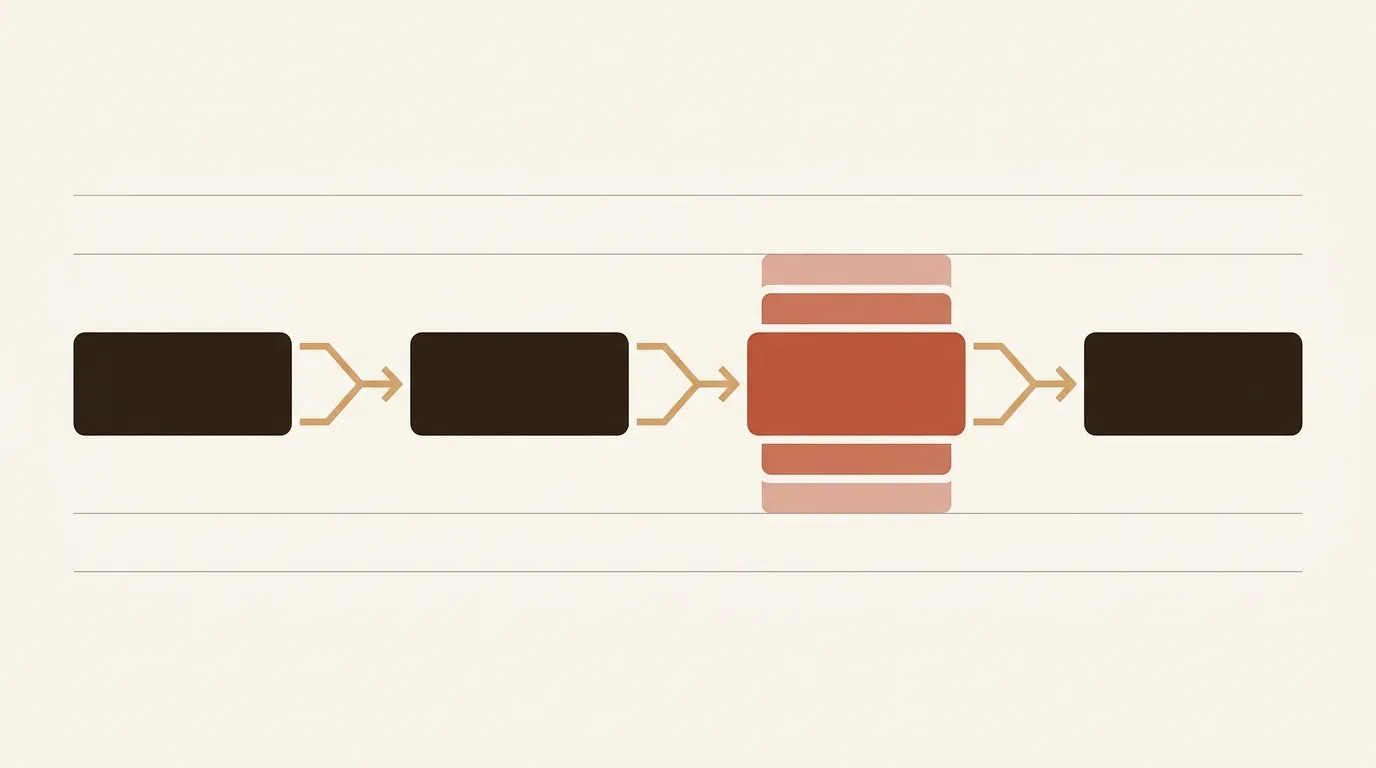
We've seen dozens of teams try to build this from scratch, and the ones that succeed tend to converge on the same four-layer architecture. Not because it's the only option, but because the integration points are well-documented and the costs stay low.
Layer 1: Airtable as the data backbone. Airtable isn't just a spreadsheet with opinions. It functions as an AI-enabled platform where automations and field agents can gather data automatically, researching tool prices, pulling feature sets, fetching logos. Tasks that humans can do, but shouldn't. Monthly cost: $0 to $120 depending on table complexity and record volume.
Layer 2: Webflow or WordPress as the publishing surface. In Webflow, you design one page template and the CMS generates a unique page for every record in your collection. WordPress achieves the same thing with custom post types and ACF fields. The choice matters less than people think. What matters is that the publishing layer accepts structured data via API and renders it without manual intervention. Monthly cost: $0 to $200.
Layer 3: AI generation with specific guardrails. This is where teams get into trouble. Successful implementations use AI for specific tasks rather than total content generation. The AI augments templates; it doesn't replace them. A programmatic page about "Slack + HubSpot integration" gets a feature matrix from structured data, then 800 to 1,200 words of contextual analysis written by an LLM that's been given the actual integration docs as source material. Monthly cost for the AI layer: $50 to $500, depending on volume.
Layer 4: Quality gates that actually kill bad pages. We'll get to this in detail below, because it's the part most teams skip. And it's the part that determines whether you survive a core update.
Total monthly run rate: $70 to $920. Well under $2,000.
What Google's March 2026 Update Actually Changed
Google's March 2026 core update re-weighted Information Gain, measuring how much genuinely new knowledge a piece of content adds relative to what already ranks. Content assembled from the same sources as competing pages does not clear that bar. What's favored: original research, proprietary data, first-hand testing, case studies built from real outcomes.
The update also shifted weight toward domain-level authority over page-level optimization. Sites that publish thoroughly within a single subject area, covering every angle and subtopic, outperform broad sites at shallow depth. A site that covers one subject thoroughly earns a compounding advantage.
This is exactly why the old approach to programmatic SEO (spin up 10,000 near-identical pages, hope some stick) stopped working. But it's also why the hybrid approach works better than it did two years ago. If you can add genuine depth to each programmatic page, and those pages live within a tightly clustered topic hierarchy, Google's algorithm actually rewards the volume.
HubSpot's blog lost roughly 85% of its organic traffic, partly due to flat architecture with no hierarchical structure and no content authority concentration. That's the cautionary tale. The antidote is what modern programmatic practitioners are building: pillar, sub-pillar, and cluster pages where every piece serves a distinct intent and authority flows upward.
The Two-Person Team Split
This is where we get specific, because "two-person team" is easy to say and hard to operationalize.
Person 1: Systems (roughly 20 hours/week). This person owns data curation, template architecture, the automation pipeline between Airtable and Webflow/WordPress, and performance monitoring. They build the Make or Zapier workflows that route structured data into page templates. They set up the AI prompts that generate contextual content for each record. They watch Google Search Console like a hawk.
Person 2: Editorial (roughly 20 hours/week). This person reviews AI-generated content for accuracy, injects proprietary insights, sources original data, and handles author credentialing. They're also responsible for the 10% sample edit, manually reviewing at least 10% of new programmatic pages every quarter.
The split is uneven in practice. Some weeks, Person 1 spends 30 hours fixing a broken automation while Person 2 is idle. Other weeks, Person 2 is buried in reviews after a batch of 200 pages goes live. That unevenness is normal. Trying to perfectly balance the workload week-over-week is a waste of energy.
What matters is that both roles exist. The best approach in 2026 is using AI to generate initial content per page, then having human review for accuracy, proprietary insight layering, and E-E-A-T signal verification. Skip the editorial layer and you're building on sand.
Quality Gates: The Part Everyone Skips
Programmatic SEO can generate 10,000+ pages automatically, but it carries a 60% failure risk without proper implementation. That number is staggering. 93% of penalized sites in one analysis lacked meaningful differentiation between pages. And traffic cliffs affect 1 in 3 programmatic implementations within 18 months.
So quality gates aren't optional. They're the difference between a traffic machine and a penalty waiting to happen.
Here's what we've seen work in practice:
Uniqueness scoring per page. Every generated page gets run through a deduplication check against its own template cluster. If two pages about "Tool A vs. Tool B" and "Tool B vs. Tool A" share more than 30% of their content verbatim, one gets flagged. The threshold we've seen most teams settle on is 70% minimum uniqueness after deduplication.
Sample editing at scale. You can't manually review every page. But you can review 10% of new pages per quarter, chosen randomly, with a structured rubric: factual accuracy, source citation quality, readability, and information gain relative to existing SERP results. This is Person 2's primary job during review weeks.
Annual deep audits with teeth. Once a year, identify the bottom 20% of programmatic pages by organic performance and deindex them. This sounds painful. It is. But killing underperformers before Google's classifiers do is the single highest-ROI maintenance task in programmatic SEO.
When to Kill a Template Cluster vs. Expand It
This is the decision that separates disciplined operators from everyone else. We think in terms of template clusters, not individual pages, because fixing a template multiplies improvements across every page using it.
Expand the cluster when individual pages average 50+ organic impressions per month with a CTR above 3%. These pages have traction. More pages in the same cluster will likely perform similarly, especially if you're adding new structured data (more integrations, more product comparisons, more city-specific landing pages).
Maintain the cluster when pages average 10 to 50 impressions per month. Something's working, but not well enough to justify expansion yet. Invest in improving the template itself: better AI prompts, richer data fields, more specific CTAs.
Kill the cluster when pages average fewer than 10 impressions per month after 6 months of indexing. Or when uniqueness scores drop below 70% after your deduplication pass. Don't agonize over this. The domain benefits from pruning.
The EU AI Act Complication Nobody's Talking About
One quick tangent, because it affects anyone running AI-generated content at scale in or targeting the EU market.
The EU AI Act's Capo III provisions begin enforcement in August 2026. Content teams using AI agents at scale will need to demonstrate which AI system produced which content, under which approval, reviewed by whom, and with what risk classification. If your pipeline doesn't log these provenance details, you're going to have a compliance problem in about six months.
This is genuinely messy. The regulation is broad enough that "AI-assisted blog content" might fall under different risk categories depending on the industry. B2B fintech content about investment products? Probably higher scrutiny than B2B SaaS content about project management tools. But the record-keeping requirements apply across the board.
Build provenance logging into your pipeline now. It's much easier to add metadata fields to Airtable before you have 5,000 pages live than after.
The Math on a 500-Page Implementation
Let's run the numbers for a realistic scenario: a B2B SaaS company building a comparison hub with 500 programmatic pages, each comparing their product to a competitor across specific use cases.
Setup costs (one-time):
- Template design and development: 40 hours × $75/hour = $3,000
- Airtable schema and automation setup: 20 hours × $75/hour = $1,500
- AI prompt engineering and testing: 15 hours × $75/hour = $1,125
- Total setup: $5,625
Monthly operating costs:
- Airtable Pro: $60/month
- Webflow CMS: $39/month
- Make (automation): $29/month
- AI generation (GPT-4o API for 500 pages, refreshed quarterly): ~$150/month amortized
- Person 1 (part-time systems): ~$2,000/month (10 hrs/week at $50/hr)
- Person 2 (part-time editorial): ~$2,000/month (10 hrs/week at $50/hr)
- Total monthly: ~$4,278
Wait. That's over $2,000 if you include labor. And it should be. The sub-$2,000 figure refers to tooling costs only: $278/month for the software stack. The labor is the labor, and pretending two people work for free helps nobody.
The relevant comparison is what you'd pay an agency to produce 500 pages of comparison content. At $200 to $400 per page (a typical agency rate for moderately researched SEO content), that's $100,000 to $200,000. The pipeline pays for itself after the first quarter, even with fully loaded labor costs.
And the sites generating 100,000+ monthly visitors from programmatic pages aren't outliers. They're the expected outcome when the template architecture matches genuine search demand and the content clears Google's depth threshold.
What Breaks First
We'd be dishonest if we didn't mention what goes wrong. Three things, in our experience, tend to break first.
Stale data. AI can keep content fresh by running pricing, feature, and integration checks weekly. But someone has to build those refresh automations, and someone has to verify the AI isn't hallucinating new pricing tiers. Person 1's job, but easy to deprioritize until half your pages show outdated information.
Template debt. You launch with one template. Six months later, you realize some pages need a different layout. You hack the template to accommodate edge cases. Twelve months in, the template is a mess of conditional logic and nobody remembers why certain fields exist. Treat templates like code. Refactor them quarterly.
Cluster sprawl. The temptation to launch new clusters is strong, especially when the first one works. But every new cluster requires its own data pipeline, its own editorial review, its own performance monitoring. Two people can realistically maintain three to five active clusters. Beyond that, quality starts degrading in ways that don't show up in dashboards until it's too late.
The teams that make this work treat their pipeline as a product. Not a project. Allocating ongoing resources for maintenance, optimization, and improvement rather than building once and walking away.
Next quarter will look different. Google's August update is already being discussed in SEO circles, the AI Act enforcement kicks in, and LLM-generated content detection is getting better fast. The pipeline you build today needs to be flexible enough to absorb those changes without a full rebuild. Plan for that now, not in August.