Most B2B content budget models still assume a 1.5-2% organic CTR for page-one results. That assumption died sometime in late 2024, and the body is getting harder to ignore.
Google's AI Overviews now swallow 58% of clicks that once went to websites, up from 34.5% in April 2025. Organic CTR on queries with AI Overviews has cratered to 0.61%, compared to 1.62% on queries without them, according to Seer Interactive's September 2025 analysis. And the expansion isn't slowing: AI Overviews appeared on 20.5% of all keywords by November 2025, up from 6.49% in January.
If your 2026 content budget still multiplies search volume by historical CTR to forecast traffic, you're building on sand. The question isn't whether to adjust. It's which production strategy still pencils out after adjustment.
The Budget Model That Broke
The traditional B2B content investment thesis goes roughly like this: spend $300 per article, publish 15 articles per month, rank for long-tail keywords with 500-2,000 monthly search volume each, expect 1.5% CTR, and build a compounding traffic curve that hits breakeven around month 8.
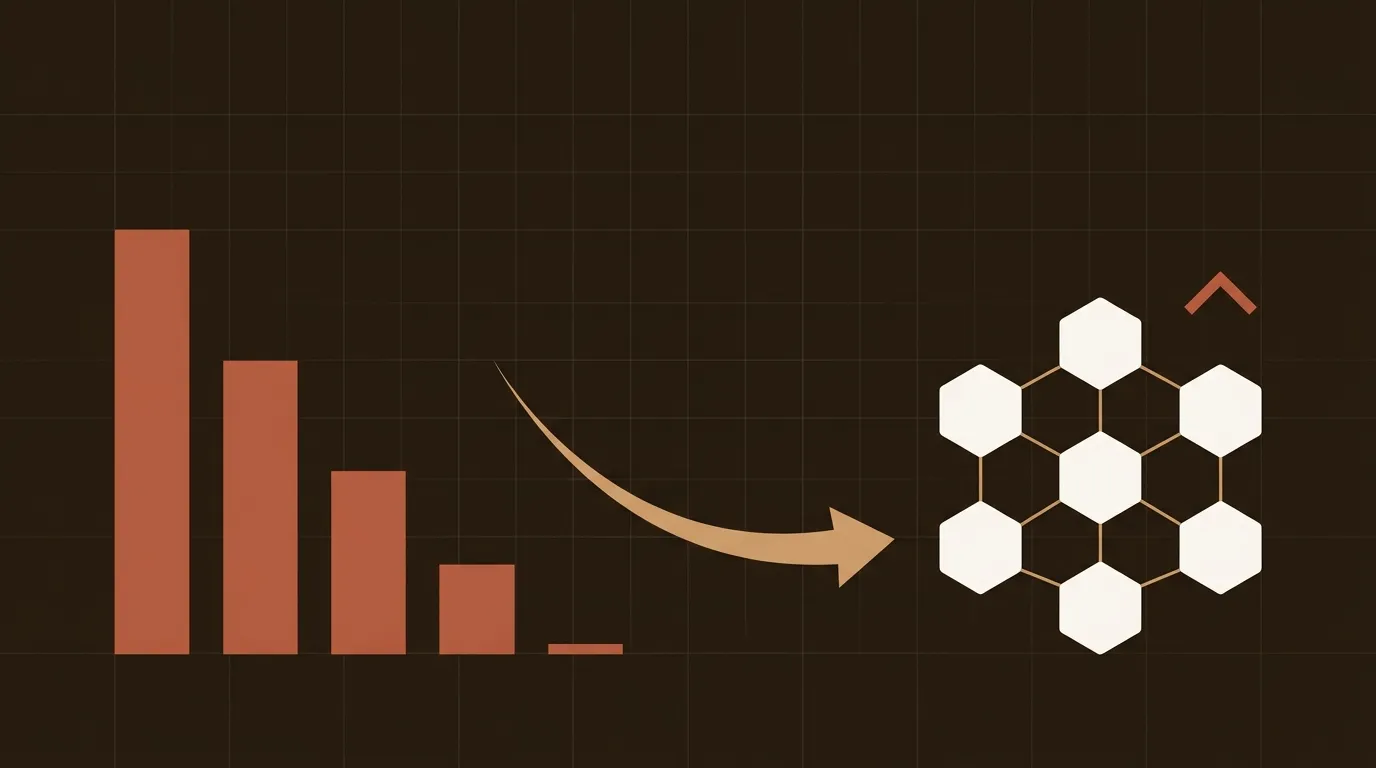
Run those numbers against 2026 reality. A keyword with 1,000 monthly searches and an AI Overview triggering on it yields about 6 clicks per month at 0.61% CTR. Not 15. Not 10. Six.
That's a 60% reduction in the traffic input of your ROI model. And it gets worse on mobile, where 77% of searches end without a click.
We've watched this play out in real portfolios. HubSpot's organic traffic dropped from 13.5 million to roughly 6, 7 million monthly visits between late 2024 and early 2025. News publishers lost half their Google search traffic in two years. These aren't small sites with thin content. These are category leaders.
The math doesn't just need updating. The entire denominator changed.
Why Programmatic SEO Survives (Conditionally)
Programmatic SEO has a structural advantage in this environment, but only if you understand why.
The advantage isn't volume for volume's sake. It's that programmatic production lets you generate pages at a cost low enough that even reduced CTR can still produce positive unit economics. A manually-written article at $300 needs significantly more traffic to break even than a programmatic page at $40. When CTR collapses by 60%, the $300 article often never recovers its cost. The $40 page might.
But there's a hard prerequisite. Programmatic SEO in 2026 only works when pages clear a quality floor that earns AI Overview citations. Brands cited in AI Overviews earn 35% more organic clicks than uncited competitors on the same queries. So the question shifts from "can I rank?" to "can I get cited?"
Citation overlap with the organic top 10 has fallen to between 17% and 54% in early 2026. Getting cited is a separate visibility layer from ranking. You can hold position three and still be invisible in the AI answer. You can hold position eight and get cited.
This decoupling is what makes programmatic SEO interesting again. And dangerous, if you ignore it.
Building the Per-Page Cost Model for a Sub-$2,000 Budget
We've built this model for teams of one to three people spending under $2,000 per month on content production. Here's how the costs actually break down.
Infrastructure (fixed monthly): $200-400. This covers your data pipeline (Airtable, Google Sheets, or a database), your automation layer (Make, n8n, or Zapier), and your CMS integration. If you're using a dedicated programmatic SEO platform, this is your subscription cost. This number stays flat whether you produce 20 pages or 200.
Data preparation and QA labor: $400-800. Someone has to clean the data, validate the inputs, and spot-check the outputs. This is the most commonly underbudgeted line item. If a developer spent three weeks building your template system, that time belongs in the cost model too.
Content editing and quality gates: $400-800. This is where citation-readiness lives. Every page needs human or AI review for differentiation, accuracy, and structural depth. We'll cover the specific quality thresholds below.
At $1,000-2,000 per month total, you can produce 25-50 pages if your automation is solid. That puts your all-in cost at $30-60 per page.
Compare that to hand-written content: 7-10 articles at $150-250 each consumes the same budget with no infrastructure investment but far less output. The per-page cost difference is 4-6x.
The Breakeven Math
Here's a specific scenario. You produce 30 programmatic pages per month at $50 per page all-in ($1,500/month). Each page targets a long-tail keyword cluster with 800 average monthly searches. At the current AIO-adjusted CTR of 0.61%, each page generates about 5 organic visits per month initially.
Sounds terrible. But two things compound.
First, not every query triggers AI Overviews. The 20.5% figure is an average across all keywords. Long-tail, niche B2B queries trigger AI Overviews at lower rates. If 60% of your targeted queries don't trigger AI Overviews, your blended CTR climbs to roughly 1.2%, yielding about 10 visits per page per month.
Second, pages that earn citations get the 35% lift. If 20% of your pages earn citations, those pages jump to roughly 13.5 visits per month.
After six months, your 180-page portfolio generates approximately 2,000-2,500 monthly visits. At a B2B conversion rate of 2.5% and $200 average lead value, that's $10,000-12,500 in monthly pipeline contribution against $9,000 in cumulative cost.
Month 6 is roughly breakeven. Month 12, with the same portfolio now generating compounding returns at zero marginal production cost, yields $10,000-12,500 per month against the original $9,000 investment. That's where the 748% ROI figures that get cited in industry reports come from.
But those figures assume you don't hit the failure modes.
The Three Failure Modes That Kill the ROI
Roughly 60% of programmatic SEO implementations fail. We've tracked the patterns, and they cluster into three categories.
Failure Mode 1: Undifferentiated Content (93% Penalty Correlation)
Google's Helpful Content signals penalize pages that add nothing beyond what's already available. In programmatic SEO, this shows up as templated pages where the only difference is a swapped city name, product SKU, or keyword variant.
The correlation between undifferentiated programmatic content and ranking penalties is stark. Pages with less than 30% unique content relative to the top five ranking results get filtered or suppressed at rates exceeding 90%.
The fix is a hard minimum: every page needs at least 500 words of differentiated content. Not 500 words total. 500 words that don't appear on any other page in your own portfolio or in the top results. This means unique data points, original calculations, local or segment-specific insights, or proprietary analysis.
This is genuinely hard to do at scale. And we won't pretend otherwise.
Failure Mode 2: No Citation Optimization Layer
Pages built for traditional ranking signals (title tags, keyword density, internal links) miss the citation signals that matter for AI Overviews. Citation-ready pages need structured data markup, clearly attributed claims with sources, and content organized in a question-and-answer or claim-and-evidence pattern that AI systems can extract.
If your template doesn't include schema markup and cited sources, you're optimizing for a visibility layer that's losing relevance.
Failure Mode 3: Measuring the Wrong Thing
Traditional rank tracking alone misses big visibility moves when answers get resolved on the SERP. Teams that only track keyword positions will see "stable rankings" while their traffic evaporates.
You need to measure AI Overview presence per query, citation share (are you cited or not), CTR changes on affected versus unaffected queries, and content refresh velocity. This is a different instrumentation layer, and most analytics stacks don't include it by default.
The Decision Framework: Programmatic vs. Manual at Each Volume Tier
Under 10 pages per month: Stick with manual. Your infrastructure costs eat the budget, and you don't have enough pages to amortize the tooling investment. Write 6-8 high-quality articles, optimize them for citations, and accept lower volume.
20-50 pages per month: Programmatic becomes defensible. Your per-page cost drops below $60, and you have enough volume to test citation optimization across different template types. Budget at least 30% of your total spend on quality gates. At $1,500/month, that's $450 specifically for editing, differentiation checks, and schema implementation.
50+ pages per month: Programmatic is the only realistic option under $2,000. Manual production at this scale costs $7,500+ per month minimum. Your per-page cost at scale ($30-40) leaves room for the quality investment that prevents penalties.
The breakeven window stretches to 6-12 months regardless of volume tier. Smaller sites in niche markets might see improvements in 3-6 months, but plan for the longer timeline.
What This Means for 2026 Planning
The zero-click environment didn't eliminate the value of search content. It raised the minimum quality bar and compressed the margin on every page. Teams that built their content operations around volume assumptions from 2022 or 2023 will overspend and underperform.
Programmatic SEO works in this environment because it's the only production method that can hit both the volume needed for portfolio-level compounding and the cost floor needed for positive unit economics at 0.61% CTR. But "works" comes with a giant asterisk: only if every page clears the differentiation threshold, only if you're instrumenting for citation presence rather than rank alone, and only if you're budgeting for quality gates as a non-negotiable line item rather than an afterthought.
The teams that will struggle most are the ones treating programmatic SEO as a shortcut to volume. It's the opposite. It's a way to make quality affordable at scale. Confuse those two things, and you join the 60%.
References
- Google AI Overviews Impact On Publishers & How To Adapt Into 2026 - Search Engine Journal
- 2025 Organic Traffic Crisis: Zero-Click & AI Impact Report - The Digital Bloom
- AIO Impact on Google CTR: September 2025 Update - Seer Interactive
- Google's AI summaries now swallow 58% of clicks that once went to websites - PPC Land
- Programmatic SEO In 2026: The Best Guide To Scaling Traffic - Zumeirah