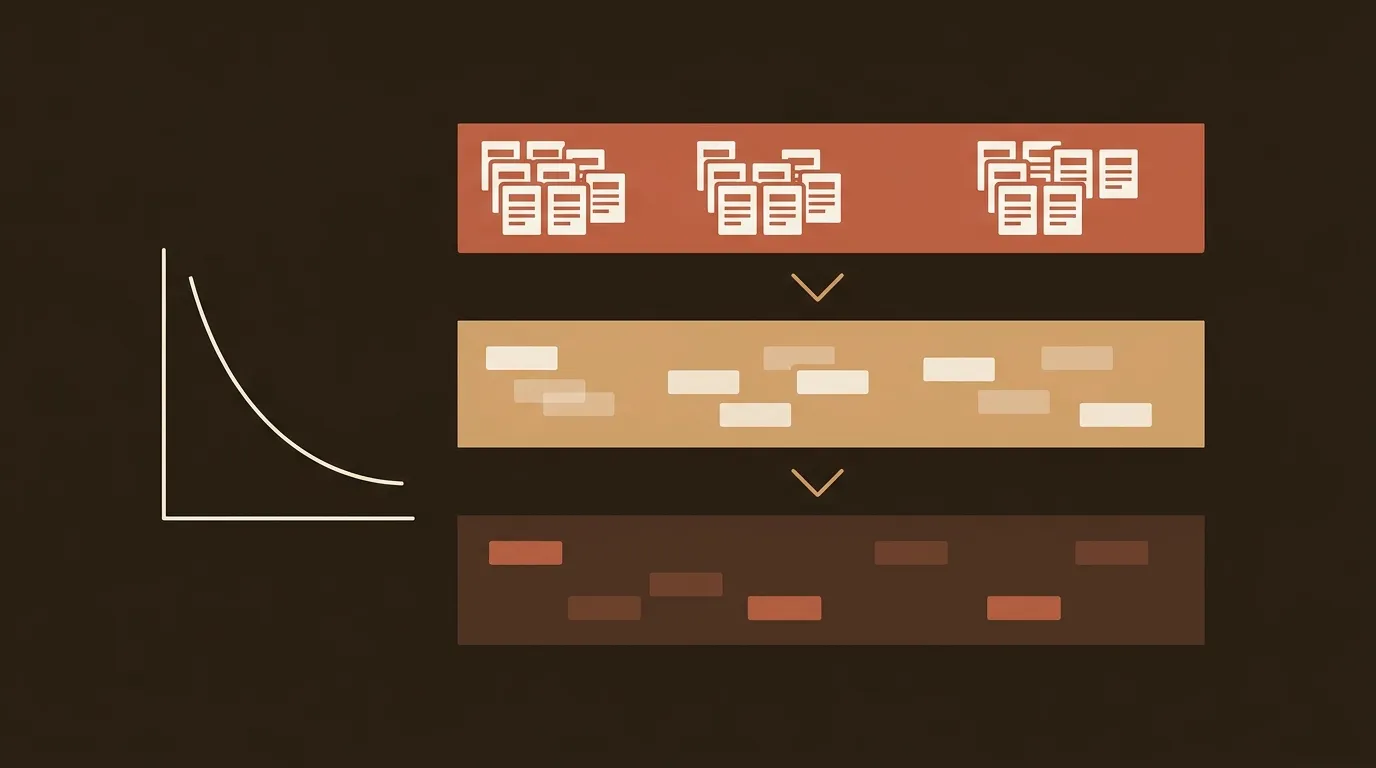

A single pillar page with 20 supporting cluster articles consistently outranks standalone long-form posts targeting the same head terms. That finding, repeated across multiple SEO studies this year, should change how every B2B content team allocates its monthly publishing budget. Yet most teams we talk to still plan content the same way: pick keywords, assign articles, publish on schedule, repeat. The math says there's a better approach.
The Obsession With Cadence Is Costing You Compounding Returns
B2B content teams love two metrics: publishing cadence and cost-per-article. A three-person marketing team shipping eight posts a month at $400 each feels productive. They're spending $3,200/month, they can see the output, and their editorial calendar looks full.
But here's what the calendar doesn't show: how those eight posts relate to each other. If they cover eight unrelated topics, each article starts from zero. No internal linking authority. No topical signal to search engines. No compounding effect where post #5 makes posts #1 through #4 rank higher.
Google's March 2026 core update re-weighted quality signals around topical coherence, rewarding domains that demonstrate sustained expertise within defined subject areas. Sites that publish deeply on one topic now outperform sites that publish broadly across many unrelated topics. That's not a marginal shift. It's a structural one.
What Topical Authority Actually Means (and Why It Beats Domain Authority)
Domain authority has been the default metric for years. Buy links, watch the number go up, watch rankings follow. That playbook still works to a degree, but sites focusing on topical authority first see ranking gains up to 3x faster than those chasing domain authority alone.
The distinction matters for budget planning. Building domain authority requires link acquisition, which is expensive and slow. Building topical authority requires depth and coherence within a subject area, which is primarily an editorial architecture decision.
For a 1-3 person content team, that's an asymmetric advantage. You don't need a $10,000/month link-building budget. You need a clear cluster map and the discipline to fill it in. One practical recommendation from 2026 SEO research suggests building at least 25-30 high-quality, interlinked articles within a single content cluster before investing heavily in link acquisition. That's a specific, measurable target a small team can work toward over two to three quarters.
The Pillar-Cluster Model Isn't New, But the Math Behind It Is
The pillar-cluster concept has been around since HubSpot popularized it years ago. What's changed is that we now have enough data to build a real ROI model around cluster additions versus isolated posts.
The architecture works like this: a single pillar page covers a broad topic (say, "B2B Email Marketing"), and 8-15 cluster pages each handle a specific subtopic in depth ("cold email subject lines," "email deliverability for SaaS," "B2B email segmentation strategies"). Lateral internal links bind the cluster together. Every new page added to the cluster benefits from the existing structure within weeks, not months.
Sites launched with a complete pillar-cluster architecture get indexed more thoroughly in the first 30 days and start picking up impressions on long-tail cluster queries within 6-8 weeks. Compare that to isolated articles, which can take 3-6 months to gain any traction on competitive terms.
The Cluster Addition Multiplier
Here's where small teams should pay close attention. When you add a new post to an existing cluster, three things happen simultaneously.
First, the new post inherits authority from the existing cluster pages linking to it. It doesn't start from zero. Second, the internal links from the new post back to the pillar and sibling pages strengthen the entire cluster's topical signal. Third, you create a new entry point for long-tail searches that funnels users into your existing content.
We've seen traffic uplifts of 15-25% across existing cluster pages when a new, well-linked article is added. That uplift compounds. Post #12 in a cluster isn't just generating its own traffic; it's lifting the performance of posts #1 through #11.
Building a "Cluster ROI" Decision Framework
So you have a limited monthly budget. Maybe you can publish 10 posts. The question isn't just "what topics?" but "where does each post sit in our topic architecture?"
Here's a concrete way to make that decision.
Option A: Add to an Existing Cluster
Take your best-performing cluster (by organic traffic or conversion rate). Identify subtopics you haven't covered yet using a content gap analysis. Then calculate the expected return.
Say your "B2B Lead Generation" cluster currently drives 4,000 organic visits/month across 8 pages. Adding a 9th page on a missing subtopic, based on the 15-25% uplift pattern, could push the cluster to 4,600-5,000 visits/month. That's 600-1,000 incremental visits from a single article. And those gains show up in 6-8 weeks, not 6 months.
The cost? One article. The return? Cluster-wide traffic growth.
Option B: Open a New Topic Area
Now consider starting a brand-new cluster on "Account-Based Marketing." The addressable search volume is large, the topic is relevant to your audience, and there's a genuine business case.
But to establish topical authority, you need the full cluster. Research suggests a pillar plus 8-12 supporting articles as the minimum viable cluster. At $400-500 per article, that's $3,600-$6,500 in content investment before you see meaningful ranking signals. And the timeline stretches to 3-4 months before search engines recognize your topical authority in the new area.
That doesn't mean new clusters aren't worth building. They absolutely are. But the expected return per article is lower in months 1-3 and higher in months 6-12. The investment profile is different.
The Decision Matrix
For any given month's budget, allocate roughly 60-70% of posts to strengthening existing clusters and 30-40% to seeding new ones. This ratio gives you compounding short-term returns while slowly building your next high-performing cluster. Adjust based on how mature your existing clusters are. If you only have one or two clusters started, go heavier on building those out before spreading thin.
Original Research: The Backlink Accelerant Inside Clusters
There's one content type that supercharges cluster performance: original research. Original research receives dramatically more backlinks than curated or opinion-based content, and the gap is widening in 2026. Data suggests websites publishing original research gain roughly 42% more backlinks than those relying on derivative content.
Place your original research as a cluster page, not a standalone asset. A survey, benchmark report, or proprietary dataset published within a cluster does double duty. It attracts external backlinks (which benefit the entire cluster through internal link equity) and it strengthens the cluster's topical depth signal.
For small teams, this means even one original research piece per quarter, strategically placed inside your strongest cluster, can produce outsized returns. The backlinks flow to the research page, the internal links distribute that authority across the cluster, and the whole structure rises.
The AI Citation Dimension
Traditional SEO metrics don't capture the full picture anymore. AI-powered search engines, from Google's AI Overviews to ChatGPT-powered search, are pulling citations from the web. And they favor topical authority.
Sites with coherent topic cluster architecture consistently outperform isolated article publishers in AI citation frequency. Brands filling content gaps with cluster pages earn roughly 2.4x more AI citations than brands without structured topic coverage.
This matters because AI citations are becoming a meaningful traffic source. They're also a signal of credibility that feeds back into traditional search rankings. A cluster that gets cited by AI engines receives a visibility boost that isolated articles simply don't.
Where This Framework Gets Messy
We'd be dishonest if we said cluster architecture solves everything cleanly. A few genuinely hard problems remain.
First, measuring cluster-level ROI is harder than measuring individual post performance. Most analytics tools report at the page level, not the cluster level. You need to build custom dashboards (or at least grouped Google Search Console views) to track cluster performance over time. It's doable but requires upfront setup.
Second, internal linking at scale is tedious. Every new cluster page needs links to and from the pillar and relevant sibling pages. Miss a few links and the topical signal weakens. This is one area where automation genuinely helps, but even automated solutions need editorial oversight.
Third, deciding when a cluster is "complete enough" to start a new one is more art than science. The 25-30 article threshold is a useful guideline, not a hard rule. Some niches need 15 articles for saturation. Others need 50.
A Quick Scenario for a 10-Post Monthly Budget
Let's say you're a two-person marketing team with $5,000/month for content. You can produce 10 articles.
Cluster A ("B2B SaaS Pricing") has 12 articles and drives 6,000 organic visits/month. Two content gaps remain.
Cluster B ("Customer Onboarding") has 5 articles and drives 1,200 organic visits/month. Seven content gaps remain.
Cluster C (new: "Product-Led Growth") has 0 articles. You've validated 15 subtopics with search volume.
An allocation that maximizes compounding returns: 2 articles to close out Cluster A (capture the full cluster effect), 5 articles to build out Cluster B toward critical mass, and 3 articles to start Cluster C's pillar and first two spokes.
By month 3, Cluster A should be driving 7,000+ visits with no further investment. Cluster B should be approaching the inflection point. Cluster C will still be in its early phase, but you'll have a foundation.
What Comes After the Cluster Is Built
Mature clusters don't just sit there. They become assets you can repurpose, update, and extend. A quarterly refresh of your pillar page (updated stats, new internal links to recent cluster additions) keeps the whole structure fresh in Google's eyes. And as your cluster ages and accumulates backlinks, the authority compounds in ways that new content simply cannot replicate.
The teams that figure this out in 2026 won't be the ones publishing the most. They'll be the ones publishing in the right places. Every article either strengthens an existing cluster or plants the seed for the next one. That's the difference between a content calendar and a content architecture.
Next quarter's winners are already mapping their clusters. The question for your team is whether your next 10 articles will be 10 isolated bets or 10 connected investments.
References
- Domain Authority vs Topical Authority: 2026 SEO Guide | SearchAtlas
- Content Cluster Architecture for Topical Authority | Ultimate Guide For Startups | 2026 EDITION
- The Complete Guide to Link Building: Lessons from 2025 & What's Coming in 2026
- Topical Authority: Build Topic Clusters That Win in AI Search (2026) | Rankeo
- Google March 2026 Core Update: What Changed & What To Do