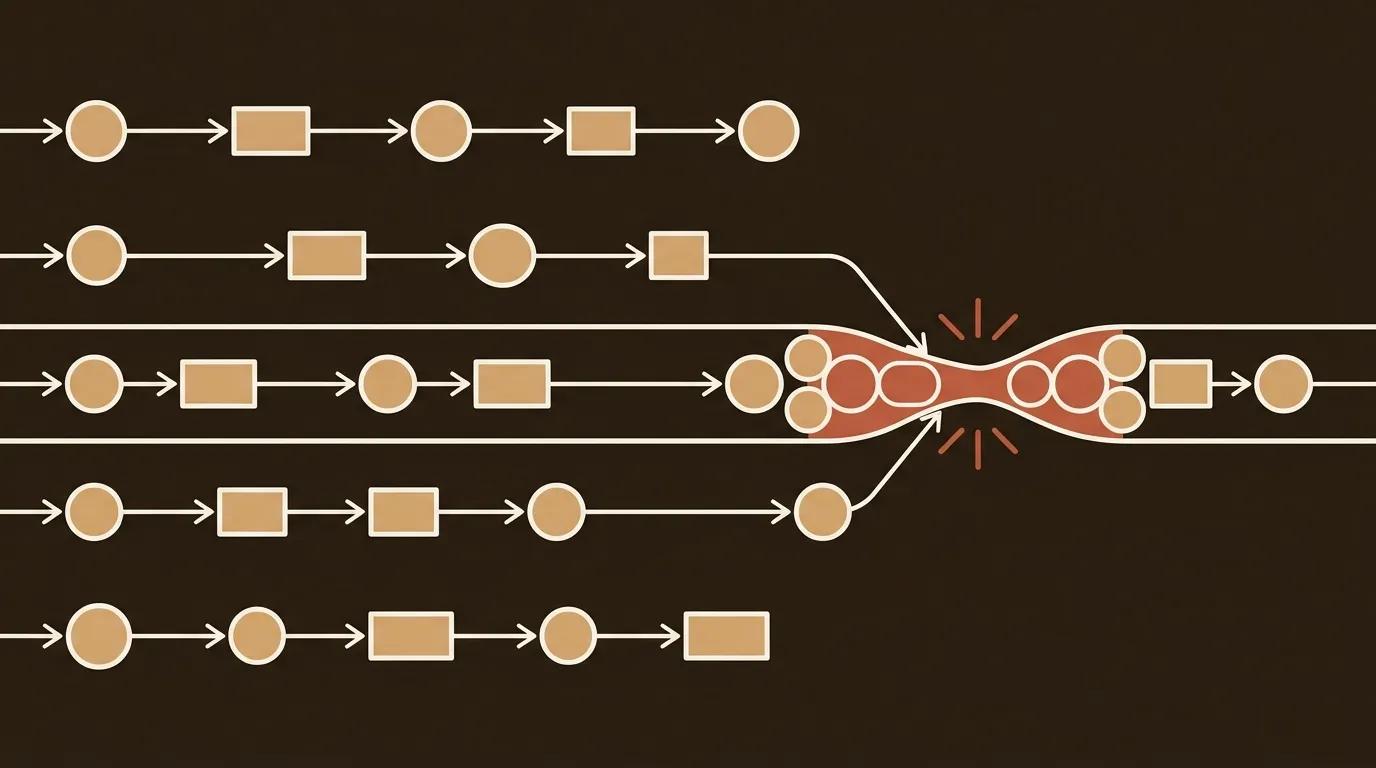

Fifty-eight percent of Google searches in 2024 ended without a click to any external website, according to Click-Vision's analysis of recent search behavior data. That number is climbing. AI Overviews now appear on over 25% of all Google searches, roughly double where they sat just months ago. And for queries that do trigger an AI Overview, the zero-click rate jumps to 83%.
If you're running content marketing for a B2B company with a small team, those numbers should change how you spend your Tuesday mornings.
The math that broke the old playbook
B2B content strategy has been built on a simple chain for over a decade: publish keyword-targeted blog posts, rank on Google, capture traffic, convert a fraction into leads. The economics worked. A well-optimized post could generate compounding organic visits for years. But that chain has a weak link now, and it's the click itself.
The Digital Bloom's 2025 organic traffic report found that market leaders in B2B SaaS have seen organic traffic erosion of 70-80%. Not small players. Market leaders. Google's shift from a referral engine to an answer engine means educational content (the exact kind B2B teams produce at scale) gets summarized directly in the SERP. The buyer gets the education. The vendor gets nothing: no pixel fire, no lead, no data.
This hits B2B disproportionately hard. B2B buying cycles average around 11 months, and top-of-funnel educational content has traditionally been the hook that starts that cycle. When Google removes the need to visit your site to consume the information, the hook dissolves.
Where AI time savings actually go (and where they should)
Here's what most teams did with the hours AI writing tools freed up: they published more posts.
That was the wrong move. Only 6% of B2B marketers reported that AI tools significantly improved content performance, per a 2025 survey by MarketingProfs and Storyblok. The reason is straightforward. AI makes content cheaper to produce, which means everyone produces more of it, which means any individual piece has less visibility in an increasingly crowded field. More supply. Same (or shrinking) demand channel.
The smarter reallocation isn't more posts. It's distribution into channels Google's AI Overviews can't touch.
Community seeding: the traffic source that doesn't depend on Google
Forums, LinkedIn groups, niche Slack communities, Discord servers, Reddit threads. These are places where your target buyers already congregate, ask questions, and share recommendations with peers. And they share a critical trait: AI Overviews don't sit between your content and the reader.
When someone shares a useful excerpt in a private Slack channel for B2B marketing directors, there's no algorithm deciding whether to show it. No AI summarizing it away. The content reaches the reader directly, with the implicit endorsement of a peer.
Fame's research on B2B content distribution strategies confirms that community-based distribution works as a relationship-first approach. You engage where your audience already gathers. You provide value before you share links. You build the kind of trust that a search ranking never provided in the first place.
And the data on LinkedIn specifically is hard to ignore: it generates 80% of B2B social media leads. But effective community seeding goes beyond just LinkedIn posts.
What this looks like operationally for a two-person team
A two-person content team that saves, say, 12 hours per week on drafting and editing through AI tools has a real budget of time to work with. The question is what to do with those 12 hours. Here's how we'd structure the workflow.
Topic selection starts in the community, not in a keyword tool. Before you outline a single post, spend 30 minutes scanning the Slack channels, LinkedIn groups, Reddit threads, and forums where your buyers hang out. What questions are they asking right now? What debates are active? The topics that generate genuine discussion in communities are the ones worth writing about, because you already know where to distribute them. Keyword volume becomes a secondary signal, not the primary one.
Write the blog post. Then write three community-native excerpts. This is where the AI time savings pay off. Take your 1,500-word post and create three reformatted pieces: a 200-word LinkedIn post that captures the most counterintuitive finding, a forum-ready response that answers a specific question with a link to the full analysis, and a Slack-friendly snippet (under 100 words) that teases the data without requiring a click. Each format respects the norms of the platform. You're not copy-pasting a blog link with "check out our latest post!" You're contributing something that would be useful even if the reader never visits your site.
Participate first, distribute second. This part is genuinely hard. It takes discipline. Before you share anything you've written, respond to other people's threads. Answer questions. React to someone else's insight. Build a pattern of contribution so that when you do share your own content, it arrives in context. ABM Agency's analysis of zero-click search impact on B2B makes the case that trust-based differentiation is now more valuable than algorithmic visibility. Community participation is how you build that trust.
Measuring pipeline from community sources
This is where most guides get vague. "Track engagement" doesn't mean anything if it doesn't connect to revenue. So let's be specific.
UTM every link, every time. Every community-shared link gets a unique UTM string. Source = the platform (linkedin, slack-community-name, reddit-subreddit). Medium = community. Campaign = the post title or content ID. This is non-negotiable. Without it, your community traffic hides inside "direct" or "social" in Google Analytics, and you'll never know what's working.
Track session-to-pipeline conversion, not just sessions. A community-sourced visitor who arrives with peer-endorsed context converts differently than an organic search visitor scanning five tabs. We've seen referral traffic from niche communities convert at 2-3x the rate of organic search traffic. The Digital Bloom's report notes that visitors arriving through AI-assisted search are worth 4.4x more than traditional organic visitors because they arrive more informed and closer to a decision. Community-sourced visitors behave similarly; they've already seen a peer vouch for your expertise.
Build a simple attribution spreadsheet. For a two-person team, you do not need a $40,000 attribution platform. A shared Google Sheet with columns for community source, post title, sessions, MQLs, and pipeline value, updated weekly, tells you everything you need to reallocate effort. After 90 days, you'll see which communities and which content formats actually drive pipeline. Double down on those. Drop the rest.
The citation-ready content angle
There's a second benefit to community seeding that plays back into search. Content that gets shared, discussed, and cited across forums and social platforms builds the exact signals that make it more likely to be cited inside AI Overviews. Sites that earn citations inside AI Overviews can see CTR increases of up to 35%. So the community distribution strategy doesn't just bypass Google's answer boxes; it actually makes your content more likely to appear in them.
This creates a reinforcing loop. Distribute in communities. Build citations and backlinks from those discussions. Increase the probability of being the source Google's AI cites. Capture the (smaller, but higher-intent) traffic that does click through from AI Overviews.
What this doesn't solve
We should be honest about the limits. Community seeding is high-effort per impression compared to ranking on a keyword with 10,000 monthly searches. It requires genuine participation, which means it doesn't scale the way programmatic SEO does. And the results take 60-90 days to become visible in pipeline data.
It also requires a specific kind of content. Generic "ultimate guides" don't get shared in communities. B2B buyers respond to well-researched content that establishes authority: original data, specific case studies, frameworks built from real experience. If your content isn't genuinely useful without the SEO wrapper, community distribution will expose that fast.
But for a two-person team that already has AI handling the first draft, the reallocation math works. Twelve hours saved on writing, redistributed into community participation and formatted distribution, creates a traffic source that compounds independently of whatever Google changes next quarter. And given Google's pace of change, that independence is worth a lot.
The teams that figure this out in 2026 won't be the ones publishing 200 posts a month. They'll be the ones whose names keep showing up in the right Slack threads.