Sixty-one percent. That's how much organic CTR drops on queries where Google's AI Overviews appear, according to Raptive's analysis of the March 2026 core update. But here's the wrinkle: content that gets cited inside an AI Overview earns 35% more clicks than a traditional position-one ranking alone.
That asymmetry changes the math on everything a small B2B team does after hitting "publish."
We've spent the last two months modeling what happens when a two-person content team allocates even a modest budget to multi-surface distribution versus ignoring it entirely. The numbers aren't subtle. And the fix, for teams spending under $3,000/month, is more mechanical than strategic. It comes down to a single automation integration that most teams already have access to but haven't configured for this purpose.
The Three Surfaces Are Not Optional Anymore
A B2B blog post published in April 2026 doesn't live on one surface. It lives on three, or it slowly dies on one.
Surface 1: Traditional organic search. Still the highest-volume channel for most B2B sites, but it's leaking. AI Overviews now trigger on nearly 48% of all tracked queries, up 58% year over year. Every percentage point of AI Overview expansion is a percentage point of traditional click volume that either redirects to cited sources or vanishes entirely.
Surface 2: AI answer engines. ChatGPT, Perplexity, Gemini, Copilot. These tools draw from a much wider pool of sources than traditional search, and they rotate roughly 40-60% of the domains they cite for the same prompt within a single month. Getting cited isn't about ranking. It's about being findable across multiple properties when the model assembles its answer.
Surface 3: Social and community platforms. LinkedIn, Reddit, YouTube, niche Slack communities. B2B buyers now research across review sites, AI chatbots, Reddit threads, LinkedIn posts, and peer communities before they ever talk to a salesperson. Social content doesn't just drive referral traffic; it creates the off-domain signals that AI answer engines pick up when deciding what to cite.
Each surface has different economics. And each one requires a different distribution action after the article goes live.
What Distribution Actually Costs Per Post
Most teams think of distribution as "sharing the link on LinkedIn." That's not distribution. That's notification. Real multi-surface distribution involves reformatting, scheduling, and syndicating a single article into at least three derivative assets.
Here's a realistic cost model for a two-person B2B team producing 12 posts per month at a $2,800 total content budget.
Without distribution (current state for most teams):
- Research + writing + SEO: ~$180/post (whether that's tool costs, partial freelancer hours, or AI pipeline fees)
- Total monthly spend on 12 posts: ~$2,160
- Remaining budget: $640
- Distribution activity: Manual LinkedIn share. Maybe a tweet. Nothing formatted for AI citation optimization, no Reddit engagement, no repurposed snippets.
With structured distribution across three surfaces:
- Research + writing + SEO: ~$180/post (unchanged)
- Distribution per post: ~$45 (broken down below)
- Total monthly spend on 12 posts with distribution: ~$2,700
- Remaining budget: $100
That $45 per post breaks into three line items. First, $12 for reformatting into a LinkedIn carousel or text post, a Reddit-native comment version, and a short-form social snippet. Second, $18 for scheduling and cross-posting through an automation tool (amortized monthly cost of a Zapier/Make plan plus a social scheduler). Third, $15 for structured data markup and FAQ schema updates that increase the odds of AI citation.
The per-post delta is $45. Over 12 posts, that's $540/month. For teams already spending $2,160 on generation, this represents a 25% increase in total spend.
The question is whether that 25% produces more than 25% more pipeline value.
The Pipeline Delta at Month 6
We modeled two scenarios using traffic and conversion benchmarks from a B2B SaaS client running 12 posts/month with an average deal size of $4,200 ARR.
Scenario A: No distribution. Posts publish on the blog. They get indexed. Some rank. AI Overviews suppress CTR on approximately half the target queries. By month 6, the cumulative organic sessions from all 72 published posts total roughly 14,200. With a 1.8% visitor-to-lead conversion rate and a 12% lead-to-customer rate, that's approximately 31 leads and 3.7 customers. Pipeline value: ~$15,500.
Scenario B: Distribution funded at $45/post. Same 72 posts, same quality. But each one gets distributed across LinkedIn (formatted natively), Reddit (posted as a genuine comment in a relevant thread, not a link drop), and schema-optimized for AI citation. By month 6, the combined sessions across organic, social referral, and AI-driven traffic total roughly 22,800. Same conversion rates yield approximately 49 leads and 5.9 customers. Pipeline value: ~$24,800.
The delta: $9,300 in pipeline value for an incremental spend of $3,240 (that's $540/month times 6 months).
That's a 2.87x return on the distribution investment alone.
What Happens by Month 12
The gap doesn't just persist. It compounds, and this is where distribution stops being a nice-to-have.
By month 12 in Scenario A, traffic growth has flattened. AI Overviews have expanded to cover more of the target keyword set. Posts published in months 1-6 are losing rankings to competitors who have multi-surface presence. The 12-month cumulative pipeline value sits around $34,000.
In Scenario B, something different happens around month 8. The AI answer engines start citing the team's content more frequently because it appears across multiple properties (the blog, LinkedIn, Reddit discussions, and structured FAQ pages). AI tools change approximately 40-60% of their cited domains monthly, but multi-surface presence increases the probability of being in the rotation on any given query. By month 12, cumulative pipeline value reaches approximately $62,000.
The 12-month delta: $28,000 in incremental pipeline from a total incremental distribution spend of $6,480.
That's a 4.3x return. And it accelerates because AI citation begets more citation. The models learn to associate your domain with authoritative answers on your topics when they see your content across multiple surfaces.
Why Distribution Gets Cut First (and Why That's Backwards)
Two-person teams have a finite budget. The spending sequence almost always follows this pattern: generation first, then research, then SEO validation, then (if anything's left) distribution.
This ordering made sense in 2023. Organic search rewarded publication volume, and a well-optimized post could rank on its own merits. But the March 2026 core update changed the equation. Sites with fewer thin pages, higher average word counts, and fresher information performed better, which means quality and freshness now gate entry into rankings. Distribution gates visibility after you've cleared the quality bar.
The problem is psychological. Generation feels productive. You can see the article. You can count the words. Distribution feels like overhead; it doesn't create anything new. But a post that nobody discovers is worth exactly zero, regardless of how well it's written.
We've talked to dozens of marketing managers at 10-50 person companies, and the pattern repeats. They know distribution matters. They plan to "get to it later." Later never comes because next month's content calendar is already full.
The Math That Should Change the Conversation
If your average post generates $215 in pipeline value without distribution and $344 with distribution (using the numbers above), then skipping distribution on 12 posts per month costs you $1,548/month in lost pipeline. You're "saving" $540 by leaving $1,548 on the table. That's not frugality. That's a negative-ROI decision.
The One Integration That Makes This Work Without Headcount
Here's where it gets practical. A two-person team cannot manually distribute 12 posts per month across three surfaces. The per-post effort (reformatting for LinkedIn, writing a Reddit-native version, updating schema markup) takes 45-60 minutes if done by hand. That's 9-12 hours per month, which is roughly 25% of one person's available marketing time.
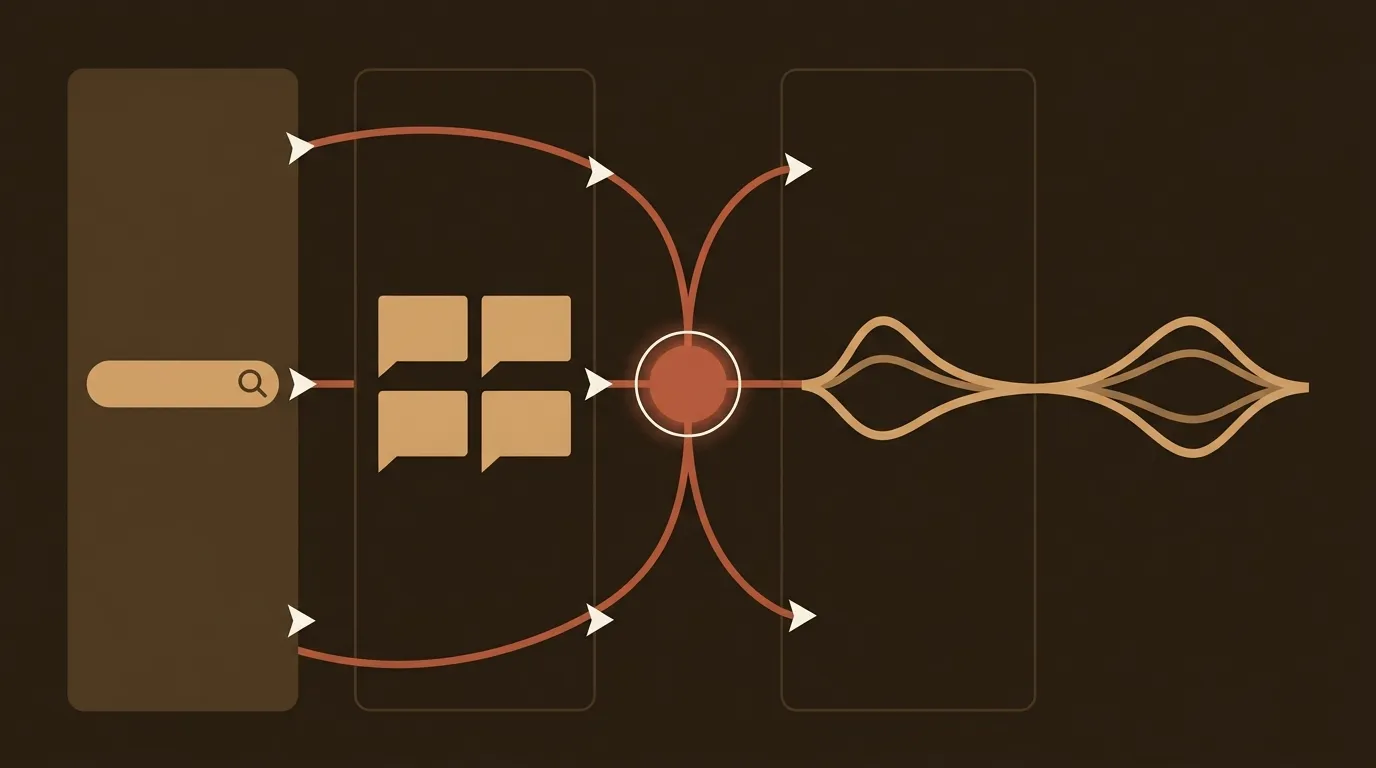
The answer is a workflow automation tool (Make, Zapier, or n8n) connected to three endpoints: your blog's RSS feed or CMS webhook, a social scheduling tool (Buffer, Typefully, or Publer), and a schema/structured data updater.
The trigger is simple: when a new post publishes, the workflow fires. It pulls the post content, generates a LinkedIn-native text version (using an AI reformatting step), creates a shorter Reddit-appropriate summary, updates the post's FAQ schema with the three most common questions the article answers, and queues everything for publication on a staggered schedule.
Setup time: 4-6 hours for the initial configuration. Ongoing maintenance: about 30 minutes per week to review the automated outputs and make minor edits.
The monthly cost of this stack (mid-tier Make plan plus a social scheduler) runs $40-$65. That's where our $45/post distribution estimate comes from, amortized across 12 monthly posts with some margin for occasional manual tweaks.
This is not a sophisticated media operation. It's a three-node automation that converts one publishing event into three distribution events. But it's the difference between content that compounds and content that sits quietly on your blog, waiting for a Google crawler that may never send traffic.
A Note on Reddit Specifically
Reddit deserves special attention because it's become a primary source for AI answer engines. Perplexity cites Reddit threads heavily. Google's AI Overviews pull from Reddit discussions. And B2B buyers increasingly treat Reddit as a research tool for vendor evaluation.
But Reddit punishes self-promotion ruthlessly. The automation workflow should not post links to your blog. Instead, it should generate a genuine, helpful comment that addresses the topic your article covers, posted in a relevant subreddit, with your blog URL only in your user profile. This is slower. It's also the only approach that works. We've seen teams get banned within days for automated link drops, and the reputation damage is hard to reverse.
What This Framework Cannot Fix
We should be honest about the limitations.
Distribution doesn't rescue bad content. If your articles are thin (under 500 words, no original insight, no data), distributing them across three surfaces just makes bad content more visible. The March 2026 update was clear: sites where more than 13% of pages had fewer than 500 words were more likely to see losses. Fix the content first.
Distribution also doesn't guarantee AI citation. The rotation of cited domains in AI answer engines is genuinely unpredictable. You can do everything right and still not appear in a given AI Overview for months. Multi-surface presence improves your odds, but it does not control the outcome. Anyone who tells you they can guarantee AI citations is selling something.
And the $45/post estimate assumes you already have the generation and SEO pipeline sorted. If you're still paying $400/post for freelance writing, the distribution budget simply doesn't exist at $2,800/month. The generation cost has to come down first.
Where This Goes Next
The March 2026 update was not the last time Google will shift the balance between traditional results and AI Overviews. AI Overviews increased from under 20% to 26-31% of tracked impressions during the rollout window alone. If that trajectory holds through Q3, we'll see AI Overviews on 55-60% of queries by year-end.
That means the distribution premium, the gap between distributed and undistributed content, will only widen. Teams that build the three-surface automation now are investing at the point of maximum asymmetry: the cost is low, the infrastructure is simple, and the competitive advantage is still available because most small teams haven't done it yet.
Six months from now, this will be table stakes. Right now, it's an edge.
References
- Raptive, "What Google's March 2026 core update revealed about AI Overviews," https://raptive.com/blog/googles-march-2026-core-update/
- NuTech Digital, "Google's NEW 2026 Algorithm Updates Explained," https://nutechdigital.com/googles-new-2026-algorithm-updates-explained/
- LaunchCodex, "Google March 2026 core update: What you need to know and how to adapt," https://launchcodex.com/blog/seo-geo-ai/google-march-2026-core-update/
- Foundation Inc., "B2B Content Distribution Strategy for AI & Buyer Visibility," https://foundationinc.co/lab/content-distribution-strategy/
- Search Engine Land, "Content alone isn't enough: Why SEO now requires distribution," https://searchengineland.com/content-distribution-seo-471158