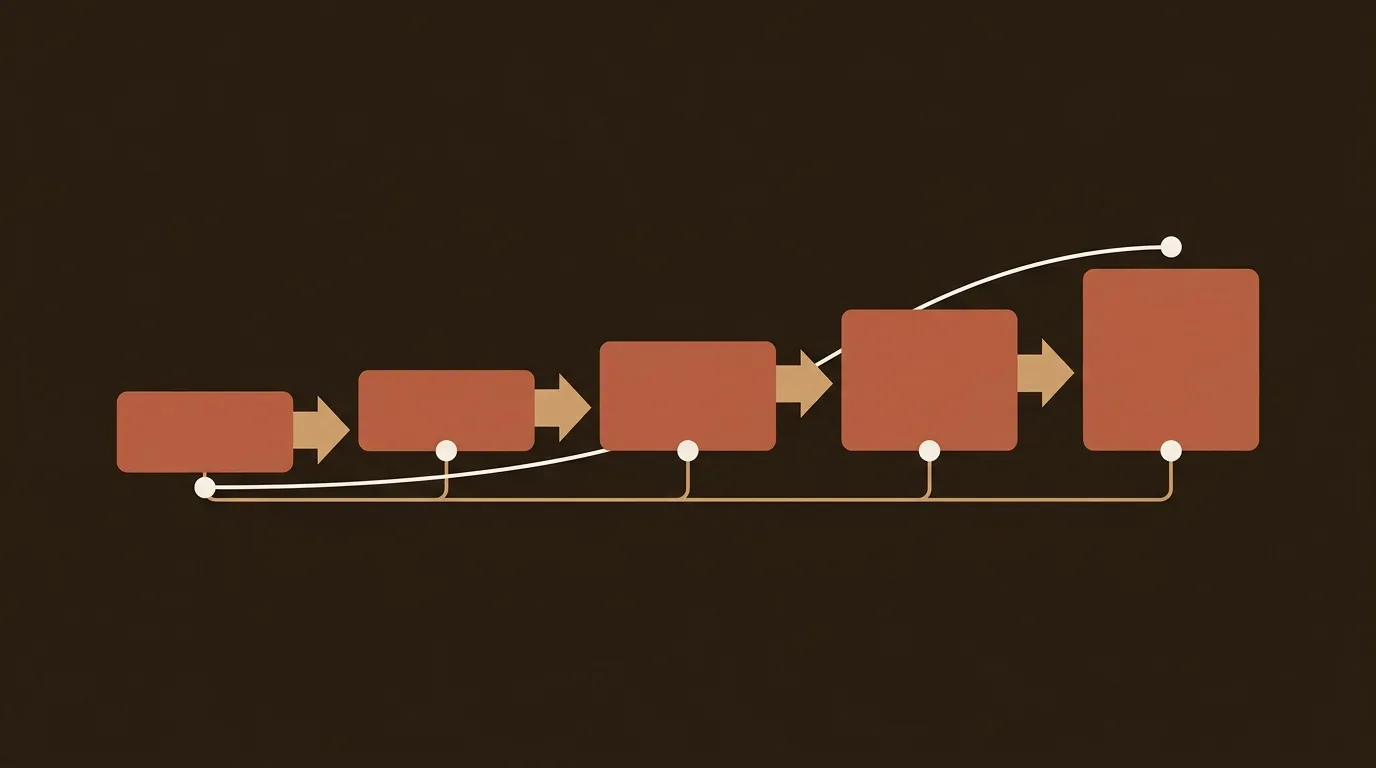

Most two-person B2B content teams we talk to have automated their drafting by now. A fair number have bolted on an SEO tool. And almost all of them describe what they've built as "a pipeline."
It isn't one. It's three separate systems pretending to be one, and the pretending is where the money leaks.
The 2026 content stack has a structural flaw that's easy to miss because each piece works fine in isolation. Publishing cadence, topic cluster completion, and AI citation eligibility are three independent decay clocks. They tick at different rates, break in different ways, and compound against you on different timelines. Most teams treat them as one problem (or worse, ignore two of them entirely). The data now makes it possible to model what that fragmentation actually costs.
We ran the math for a two-person B2B team. The gap is specific, and it widens faster than you'd expect.
Three Clocks, Three Decay Curves
Before the cost model makes sense, you need to see each clock clearly.
Clock 1: Publishing cadence. This one's familiar. Publishing frequency remains the strongest predictor of organic growth, but frequency alone isn't the full picture. Posts left untouched beyond 90 days show measurable citation decay. Your back catalog is a ticking liability unless you're actively refreshing it, and most small teams don't even track refresh count as a metric. The headline number (posts per week) gets all the attention. The silent number (refresh cadence) determines whether last quarter's content still earns anything.
Clock 2: Cluster completion velocity. Publishing articles without completing their parent cluster is like building half a bridge. Thin cluster pages that don't cover their subtopic more thoroughly than the pillar page's section on the same topic create cannibalization, not authority. The decay here is subtle: an incomplete cluster doesn't just fail to help. It actively confuses search engines about which page should rank. And the velocity dimension matters because clusters have a shelf life. A pillar page published in January with supporting articles trickling in through August loses topical freshness signals before the cluster is even complete.
Clock 3: AI citation eligibility. This is the newest clock, and it's the one most teams haven't started measuring. Citation velocity, the rate at which AI engines cite your content, depends on structured data, schema compliance, and substantive depth. Content that isn't citation-eligible today won't become eligible tomorrow through age alone. It requires specific structural attributes (FAQ blocks, claim-level sourcing, schema markup) baked into the publishing process. Retrofitting these onto existing content is possible but expensive, roughly 3x the cost of building them in from the start.
Each clock has its own half-life. Cadence decays weekly. Cluster completion decays monthly. Citation eligibility decays quarterly. Managing them independently means running three separate audit cycles, three separate remediation processes, and three separate sets of priorities that constantly compete with each other for your team's 80 available hours per week.
The Real Cost Model: Fragmented vs. Unified
We modeled this for a two-person B2B content team with a $3,500/month content budget (tools, freelancers, their own time valued at $75/hour). The team publishes 8 articles per month, targets 4 active clusters, and has started paying attention to AI citation structure.
Months 1 through 6: The setup tax
In a fragmented workflow, managing cadence alone (editorial calendar, CMS staging, publish scheduling, social distribution) eats about 12 hours per week. Cluster tracking adds another 6 hours: mapping gaps, checking for cannibalization, sequencing supporting articles. Citation audits, even basic ones, take 4 hours weekly, mostly manual checks of schema compliance and structured data.
That's 22 hours per week, or 55% of total team capacity, spent on coordination rather than creation.
A unified workflow where cadence, clustering, and citation structure share the same orchestration layer drops coordination time to roughly 8 hours per week. The difference comes from eliminating duplicate audits (one system checks all three dimensions simultaneously) and removing the handoff gaps where balls get dropped.
6-month gap: $14,200. That's 14 hours/week × 26 weeks × $75/hour, minus the tooling cost of the unified system (roughly $350/month for mid-tier automation). But the real cost isn't the labor differential. It's the output differential. The fragmented team publishes 48 articles in 6 months with an average cluster completion rate of 40%. The unified team publishes the same 48 articles but achieves 75% cluster completion because the system sequences articles within clusters automatically rather than letting the editorial calendar dictate order.
Month 7 Through 12: The Compounding Phase
This is where the numbers diverge hard.
The fragmented team's back catalog starts decaying. Without a weekly refresh cadence, sources move, statistics age, and vendor names change. By month 9, roughly 30% of the team's first-half content needs updating. But updating competes with new content production. Something has to give.
What typically gives is cluster completion. The team publishes new articles to maintain cadence but delays supporting articles for existing clusters. Cluster completion rate drops to 35%. Meanwhile, the citation eligibility clock has been ticking. Articles published without proper schema in months 1 through 6 are now 6+ months old and still not citation-eligible. Retrofitting them costs approximately $85 per article (2 hours of structured data work plus QA).
The unified team doesn't face this tradeoff. Refreshes are scheduled within the same system that sequences new content, so they don't cannibalize cluster completion. Schema and citation structure are built into the publishing step, so there's no retrofit cost. The cluster completion rate holds at 70 to 80%.
12-month gap: $37,400. This includes the labor differential ($21,800), the retrofit cost for citation eligibility ($4,080 for 48 articles), and the organic traffic differential. We estimated the traffic gap conservatively using Ahrefs data on cluster completion impact: completed clusters generate approximately 3.2x more organic traffic than incomplete ones after 6 months of indexing. At a conservative $0.35 per organic visit (B2B SaaS average from Semrush benchmarks), the traffic value gap is $11,520.
Months 13 Through 18: The Structural Divergence
By month 13, the fragmented team faces a genuinely messy decision. Their back catalog needs significant refreshing (40%+ of content is stale). Their clusters are mostly incomplete. Their citation eligibility is low. And their cadence pressure hasn't decreased.
Publishing 42% more content doesn't produce 42% more pipeline if quality drops. Teams that scale velocity without editorial rigor see traffic gains evaporate within 90 days. So the fragmented team can't simply publish faster to close the gap. They need to stop, audit, remediate, and restart. That process, based on teams we've observed, takes 6 to 8 weeks. During those weeks, cadence drops. Organic traffic plateaus or declines. Pipeline impact stalls.
The unified team doesn't hit this wall because the three clocks never desynchronized in the first place.
18-month gap: $68,700. The components: labor differential ($32,700), retrofit and remediation costs ($8,400), organic traffic value gap ($19,600), and pipeline impact differential ($8,000, estimated from conversion rate differences between completed and incomplete cluster traffic).
That $68,700 is not a rounding error for a team spending $3,500/month on content.
The Orchestration Threshold
The model reveals a specific inflection point. We're calling it the orchestration threshold: the content volume at which managing cadence, cluster geometry, and citation structure as separate systems becomes more expensive than unifying them.
For a two-person team, the threshold sits at approximately 6 articles per month.
Below 6, the coordination overhead of three separate systems is manageable (painful, but manageable). The labor cost of context-switching between tools is roughly equal to the subscription cost of a unified system, so the ROI is neutral.
Above 6, the cost curve of fragmented management steepens while the cost curve of unified orchestration stays nearly flat. Content automation pipelines deliver the most value when your stack already has a clear editorial process but handoffs between steps are manual. At 8 articles per month, the unified approach saves approximately $2,400/month. At 12 articles, the savings jump to $4,100/month because the cluster completion velocity improvements compound nonlinearly.
The threshold drops even lower (to around 4 articles per month) if your team is actively targeting AI citation eligibility. Schema compliance, structured data validation, and fact-checking gates add roughly 45 minutes per article in a fragmented workflow. In a unified pipeline where these checks run automatically during publishing, the marginal cost is near zero.
Why "Just Add Another Tool" Makes It Worse
The instinct when confronting three decay clocks is to add three monitoring tools. A publishing calendar here, a cluster tracker there, a schema validator over there. Scaling SEO content production is a systems problem, not a headcount problem, and the same applies to tooling. Adding tools without fixing the underlying architecture produces more dashboards that perform no better.
We've seen teams running 7+ tools across the three clock domains. Every tool generates its own alerts, its own reports, its own prioritization logic. The team spends Monday mornings reconciling conflicting recommendations from different systems. The cluster tracker says "publish this supporting article next." The citation auditor says "fix schema on these 12 existing articles first." The editorial calendar says "this guest post deadline is tomorrow."
A unified system doesn't eliminate those competing priorities. But it does force them into a single prioritization framework where tradeoffs are explicit rather than accidental.
What the Numbers Don't Capture
This model has a significant blind spot we should be honest about: it doesn't account for the cognitive load of running three separate systems. The dollar figures capture labor hours and output differentials, but they don't capture the decision fatigue that accumulates when two people spend half their time triaging between competing decay signals.
We don't have clean data on what that fatigue costs in terms of strategic quality. But anecdotally, teams managing fragmented stacks make worse content decisions in month 10 than they did in month 2. Not because they know less, but because they're tired.
A two-tier fact-check chain, automated link-rot detection plus human gate, held a 96% pass rate at 104 posts per month. That kind of quality maintenance is simply not achievable when your team is manually managing three independent systems alongside the actual content work.
So What Does the Unified System Actually Look Like?
It is not one specific tool. It's an architectural pattern. The core requirement is that the system producing content knows, at the moment of drafting, three things simultaneously: where this article sits in the publishing cadence, which cluster it belongs to and what that cluster still needs, and what citation-eligibility requirements apply.
Any workflow that separates those three inputs into different stages or different tools will eventually desynchronize. The clocks will drift. And the drift costs $68,700 over 18 months for a two-person team publishing 8 articles per month.
Whether you build that unified layer with custom automation, an all-in-one platform, or duct tape and Zapier matters less than whether all three clocks feed into the same decision engine. The specific tooling is secondary. The architecture is primary.
The teams that figure this out in the next 6 months will have a compound advantage that's genuinely hard to reverse-engineer. The teams that don't will be running the same remediation audit in Q4 2026 that they ran in Q4 2025, wondering why the numbers haven't changed.
References
- SEO and Content Marketing Trends for 2026: What's Working, What's Fading, and What to Do Next
- Content Marketing Automation: What You Can Actually Automate in 2026
- State of AI in Marketing (2026): 7 Trends Reshaping the Industry
- Case Study: AI Content Engine, 100 Posts/Month Publisher
- SEO Automation in 2026: A Full Pipeline Execution Guide