
51% of B2B software buyers now begin their software research in an AI chatbot rather than a traditional search engine, according to G2's latest buyer behavior study. That number was 29% just twelve months earlier. A 22-point swing in a single year.
And yet most content teams we talk to are still building editorial calendars around a single input: Google keyword search volume. They're optimizing for a discovery channel that, for their specific buyers, may no longer be the primary one. This isn't a prediction about some distant future. It's a budget misallocation happening right now, before a single word gets written.
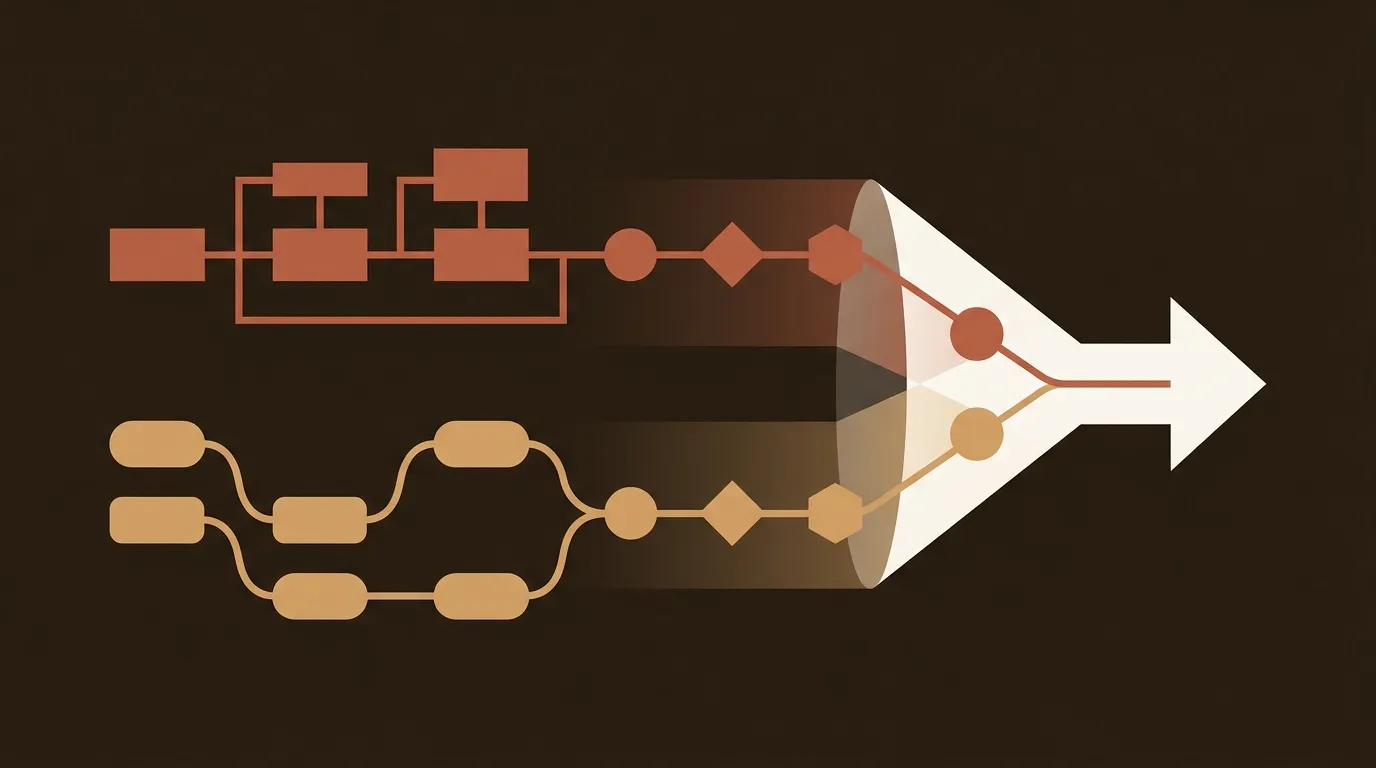
This post walks through a concrete process we're calling a demand-signal audit. The output is a single reallocation number: how many of your monthly posts should target traditional SERPs, how many should target AI chatbot citation slots, and how many should aim at Google's AI Overviews. Expressed in posts per month and dollars per stage. Designed for teams spending under $3,000/month on content.
The Discovery Shift Happened Faster Than Anyone Modeled
The G2 data alone would be enough to force a rethink, but it's not isolated. Apollo's 2026 B2B buyer journey analysis shows that 61% of the B2B buying journey completes before the buyer contacts a vendor. That figure increases when AI tools provide synthesized comparisons that previously required multiple site visits, multiple tabs, multiple content pieces. The buyer gets their answer in one prompt.
Loganix's analysis of over 1,000 B2B purchasers found that 89% of B2B buyers now use generative AI for self-guided research. Even more telling: 69% of buyers chose a different software vendor than they initially planned, based on AI chatbot guidance. Your content isn't just competing for attention anymore. It's competing for citation, inside a tool that synthesizes answers and makes recommendations.
Here's the conversion data that should change how you think about budget allocation: AI search traffic converts at 14.2% compared to Google organic's 2.8%. That's a 5.1× advantage. If your cost per article is the same across channels but one channel converts at five times the rate, the math is simple. You're leaving money on the table every month you don't rebalance.
Why Google Search Volume Is Now Only One-Third of the Signal
We're not saying Google doesn't matter. It does. But search volume data from Ahrefs or Semrush tells you one thing: how many people type a query into Google. It does not tell you how many people ask that same question to ChatGPT, Perplexity, or Gemini. And right now, there's no equivalent of "search volume" for AI chatbot queries. No one has that data at scale.
So content teams default to what they can measure. They build editorial calendars around Google keyword data because it's available, exportable, and familiar. The problem isn't the data. The problem is treating partial data as complete data.
ChatGPT commands roughly 65% of AI chatbot traffic. Google Gemini has surged to 21.5%. Perplexity has carved out a citation-focused niche. Each one cites different sources, pulls from different indexes, and rewards different content structures. The overlap between ChatGPT results and Google's SERP is just 12%. Only 26% overlap with Bing. Nearly 90% of AI citations come from completely different sources depending on which model the user queries.
That fragmentation is the real editorial planning challenge for 2026.
The Citation Economy: Five Slots, Not Ten Blue Links
Google's old model rewarded rank position. Position 1 got ~27% of clicks. Position 10 got maybe 2%. But you had ten shots on the first page.
AI engines cite a median of five URLs per response. Five. And 62% of AI Overview citations come from pages that are NOT in the top-10 organic results for the query. This means two things simultaneously: your top-ranking pages aren't guaranteed citation slots, and your lower-ranking pages have a real shot at visibility they never had in traditional search.
The signals that earn citations are structurally different from the signals that earn rankings. Pages with Article and BreadcrumbList schema were cited 2.3× more often than unstructured equivalents. Adding HowTo schema pushed that multiplier to 2.8×. Pages over 2,500 words get cited 1.6× more often, but the lift starts around 1,800 words and saturates around 3,500.
And the tempo is different too. 70% of pages cited in AI Overviews change citation status within 2 to 3 months. This isn't a "set it and forget it" optimization. It's closer to social media velocity than traditional SEO patience.
Running Your Demand-Signal Audit
We've broken this into three steps that a one-to-three person team can complete in two weeks without hiring anyone or buying new tools.
Step 1: Citation Audit (Week 1)
Pick 25 to 50 prompts that a buyer in your category would type into ChatGPT, Perplexity, and Google's AI Mode. Not your keywords. Your buyer's questions. "What's the best project management tool for a 10-person agency" is a prompt. "Project management software" is a keyword. Different things.
Run each prompt through ChatGPT, Perplexity, and Google AI Mode. Record which URLs get cited. Use a spreadsheet. (Yes, really. At this scale, a spreadsheet beats a platform.) If you have budget, tools like Ahrefs Brand Radar, SE Ranking, or Otterly can automate parts of this. But the manual version works fine for 50 prompts.
What you're looking for: where do competitors appear and you don't? Which of your existing URLs already earn citations? Which prompts return zero results from your domain?
One non-obvious finding from our own audits: sources that appear across multiple AI platforms (cited by ChatGPT and Perplexity and AI Overviews) tend to share specific structural traits. Answer-first formatting. Clear heading hierarchies. Schema markup. These cross-platform winners should get your first optimization attention.
Step 2: Intent Mapping (Week 1 to 2)
Traditional keyword research maps one keyword to one page. Citation optimization maps one primary query to multiple sub-queries, because AI chatbots generate follow-up questions. Each follow-up is a potential citation slot.
Use Google's People Also Ask, related searches, and AI Mode's conversational follow-ups to identify the sub-queries that fan out from your primary prompts. A query like "best CRM for startups" might generate follow-ups about pricing tiers, migration difficulty, integration with specific tools, and comparison with named competitors. Each of those is a citation opportunity.
Definitional and how-to queries are the highest-opportunity intent classes for sites outside the top 1% by domain authority. Citation lists are longer for these query types, the source pool is wider, and page-level signals (schema, structure) carry more weight relative to pure domain authority. If you're a 30-DR site competing against a 90-DR site, these are the queries where you have the best odds.
Step 3: Reallocation Math (Week 2)
This is where the audit produces a number you can act on. For every 10 posts per month in your current calendar, here's how the reallocation breaks down based on where your buyers actually start their research.
If your buyers primarily use Google (this is increasingly rare in B2B SaaS, but still true in some verticals like manufacturing or construction): allocate 6 to 7 posts to SERP optimization. Budget: $800 to $1,200/month.
If your buyers split roughly 50/50 between Google and AI chatbots: allocate 3 to 4 posts to traditional SERP topics and 3 to 4 posts to citation-optimized content (comparison pieces, structured how-tos, industry publication pitches, Reddit and G2 presence). Budget: $1,000 to $1,500/month.
If your buyers start with AI chatbots (51%+ per the G2 data, which applies to most B2B software buyers): allocate 2 to 3 posts to SERP and 5 to 6 posts to multi-platform citation strategy. Budget: $1,500 to $2,000/month.
Notice that the total budget doesn't necessarily increase. The mix shifts. You're spending the same $2,000 per month but putting it in different places.
What "Citation-Optimized Content" Actually Looks Like
This is genuinely messy, and we don't want to pretend otherwise. There's no equivalent of "write a 1,500-word blog post targeting this keyword" for citation optimization. The playbook is still forming. But some patterns are clear.
Put your core finding or definition in the first 20% of the page. Not after the third subheading. Not after a warm-up paragraph. AI models extract from the top of the page disproportionately. Google's AI Mode documentation confirms that answer-first formatting increases the probability of citation in both AI Overviews and AI Mode responses.
Build each section around a clear question with a direct 40-to-60-word answer right under the heading. Then expand. AI models favor concise, self-contained snippets. They don't read your brilliant 800-word narrative arc. They extract the paragraph that most directly answers the query.
Schema matters more than we expected. Pages with structured data get cited at 2.3× to 2.8× the rate of unstructured pages. For a content team, adding FAQ schema and HowTo schema to existing high-authority pages is probably the single highest-ROI activity available right now. No new content needed.
And then there's the off-platform piece. Reddit accounts for 46.7% of top Perplexity citations. G2 reviews influence ChatGPT's software recommendations. Industry publications get cited across all platforms. So "content" for citation purposes isn't always a blog post on your domain. Sometimes it's a detailed Reddit answer, a G2 profile update, or a guest contribution to an industry publication.
Measuring What Matters: Citation Share, Not Just Click Share
Set up tracking across three metrics.
Citation share: the percentage of AI responses where your brand or URL appears, segmented by platform. Track this weekly, not quarterly. Citation status changes fast.
Citation velocity: how quickly your citations change after a content update. Baseline expectation: 2 to 4 weeks for schema and title changes, 4 to 8 weeks for substantive content edits.
AI referral traffic: create a GA4 segment for traffic originating from ChatGPT, Perplexity, and Google AI Mode. Check your server logs if referrer data is spotty, because some AI platforms strip referral headers.
The awkward truth is that none of these metrics are as clean as Google Search Console data. Citation tracking tools are young. The data is incomplete. But waiting for perfect measurement means losing 12 to 18 months of positioning advantage in a channel where your buyers are already active.
The Two-to-Four Post Shift
For most teams under $3,000/month, the reallocation number lands between 2 and 4 posts per month redirected from low-impact SERP topics to high-value citation surfaces. In practice, that might mean shifting from producing 8 blog posts per month to producing 5 blog posts, 1 structured Reddit strategy post, 1 G2 review campaign push, and 1 industry publication pitch.
Different workload. Different distribution of effort. But the same team, the same budget, and measurably better alignment with where B2B buyers actually discover content in 2026.
The teams that will adapt fastest are the ones that stop treating "content production" as synonymous with "blog posts on our domain." Your editorial calendar is a budget allocation tool. Right now, most of those budgets are allocated based on a discovery channel that represents half (or less) of where your buyers begin. The audit takes two weeks. The reallocation takes one editorial planning meeting. The results show up in 30 to 90 days.
We'll be tracking citation economics closely over the next few quarters, because the platforms are still shifting and the measurement tools are still catching up. If the G2 data moves another 10 points toward AI chatbots by mid-2026, even the conservative reallocation numbers above will need revision.
References
-
G2 Research: Half of B2B Software Buyers Now Start Their Research With AI Chatbots -- https://www.prnewswire.com/news-releases/new-g2-research-half-of-b2b-software-buyers-now-start-their-research-with-ai-chatbots-302742807.html
-
What's Changed in the B2B Buyer Journey in 2026? | Apollo -- https://www.apollo.io/insights/b2b-buyer-journey
-
73% of B2B Buyers Use AI Tools in Purchase Research - Loganix 2026 Analysis -- https://finance.yahoo.com/sectors/technology/articles/73-b2b-buyers-ai-tools-231200431.html
-
1,000 AI Overviews Analyzed: Citation Pattern Study -- https://www.digitalapplied.com/blog/we-analyzed-1000-ai-overviews-citation-pattern-study
-
Google AI Mode Vs. Traditional Search: A Guide For Brands -- https://www.yotpo.com/blog/google-ai-mode-vs-traditional-search/