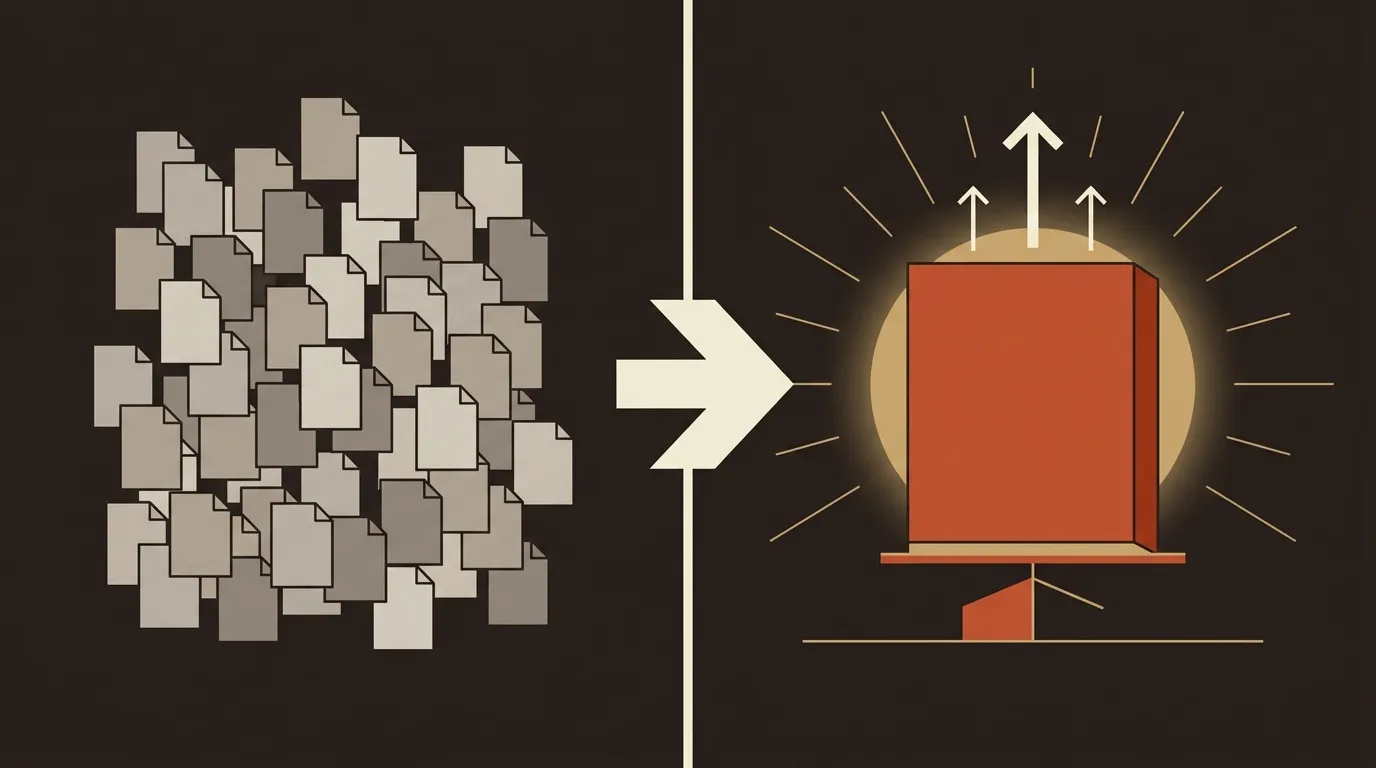

The 2010s taught B2B marketers one lesson above all others: publish consistently, optimize for keywords, and organic traffic will compound. For roughly a decade, that was true. We ran that playbook ourselves, and it worked well enough that an entire industry of content agencies, freelancer networks, and SEO tooling grew up around it.
That playbook is now breaking in measurable ways. And the interesting question isn't whether it's broken (it is), but which pieces deserve a proper burial versus which still hold structural weight under completely different conditions.
The Numbers That Changed Everything
Organic search clicks have dropped 42% cumulatively since Google AI Overviews expanded. Not a gradual erosion. A cliff.
The mechanism is straightforward: 58.5% of Google searches now produce zero clicks. For queries where AI Overviews appear specifically, that zero-click rate hits 80-83%. Four out of five users get their answer without visiting any website.
Then Google's March 2026 core update landed. Over 55% of tracked sites saw ranking shifts within days of rollout. The update didn't just reshuffle results; it raised the floor for what counts as useful content. Pages that were "good enough" in 2023 suddenly looked weak against competitors who'd been building genuine topical authority.
So here we are. The assumptions baked into a decade of content marketing strategy are being stress-tested in real time.
Three 2010s Tactics That Are Now Actively Harmful
Volume-First Publishing
The most persistent idea from the 2010s was that publishing frequency itself was a growth lever. More pages meant more indexed URLs, more long-tail keyword coverage, more surface area for traffic. HubSpot's early research reinforced this, showing companies that blogged 16+ times per month got 3.5x more traffic than those blogging 0-4 times.
That math assumed Google would continue rewarding volume. It doesn't. The March 2026 update specifically targets websites with content created to rank well rather than genuinely help people. High-frequency, thin content isn't just ineffective now. It's a liability. And 83% of marketers have caught on, saying it's better to focus on quality over quantity even if it means posting less often.
We've seen this firsthand with clients who had 400+ blog posts and were getting outranked by competitors with 40 deeply researched articles. The bloat was actively hurting them.
Click-Optimized Headlines Without Substance
The 2010s perfected the art of the click-worthy headline. "10 Ways to..." and "The Ultimate Guide to..." became templates because they worked. CTR was the metric, and optimizing for it felt scientific.
But the March 2026 update tightened weighting on Experience and Authoritativeness signals. Sites without clear author credentials, first-person experience markers, or demonstrable expertise saw the sharpest drops. A perfectly optimized headline attached to generic content is now worse than a boring headline on an article written by someone who clearly knows the subject.
Generic Informational Content
This is the one that hurts the most, because it represents the bulk of what B2B companies published throughout the 2010s. "What is [industry term]?" posts. Glossary pages. Broad overviews designed to capture top-of-funnel informational queries.
Those informational queries are exactly where AI Overviews dominate. The highest-volume informational queries, the ones that used to drive the most organic traffic, are precisely the ones AI Overviews now answer directly. If your content strategy still relies on capturing these, you're building on ground that's already given way.
The Citation Economy Is Real, and It Inverts the Old Playbook
Here's where things get genuinely interesting instead of just depressing.
A September 2025 study by Seer Interactive found that organic CTR plummeted 61% for queries with AI Overviews, falling from 1.76% to 0.61%. But brands cited within those AI Overviews? They earned 35% more organic clicks and 91% more paid clicks than non-cited brands.
Read that again. Being cited by AI doesn't just prevent traffic loss. It amplifies existing traffic. AI acts as a trust signal, and users who do click through are more qualified.
This completely inverts 2010s logic. The old game was: rank high, get clicks, hope some convert. The new game is: become a source that AI systems trust enough to cite, and the clicks you do get are worth more per visitor.
We don't have a perfect formula for earning citations yet, and anyone claiming they do is selling something. But the data points in a clear direction. Articles based around original data or stats accounted for 50% of clicks from AI sources, while those same pages made up only 5% of clicks from traditional organic search. AI tools link to data sources, and users click through to verify.
Proprietary research is the new backlink. Except it's harder to fake.
What the 2010s Actually Got Right
Not everything from the last decade was wrong. Some principles have only gotten stronger, even as the tactics built on top of them collapsed.
Topical depth is more important than ever. The 2010s idea of "topic clusters" and "pillar content" was directionally correct. Broad, shallow coverage is being deprioritized in favor of specific, well-organized content. The difference now is that depth can't be faked with word count. A 5,000-word article that's just a rehash of the top 10 results gets treated the same as thin content. Depth means original insight, data, or perspective that doesn't exist elsewhere.
Audience specificity compounds. Google now better assesses not only expertise and authority but real-world experience. Writing for a specific audience, with specific problems, in specific language, has always been the right approach. The 2010s tolerated vagueness because Google couldn't tell the difference. Now it can. And so can AI systems deciding which sources to cite.
Content as a compounding asset still works. The 2010s logic that each blog post builds on the last, creating cumulative authority, remains sound. What changed is the timeline and the mechanism. You're no longer compounding indexed pages. You're compounding trust signals, citation frequency, and audience recognition. That takes longer but decays slower.
The Measurement Problem Nobody Wants to Talk About
Attribution in 2026 is genuinely messy, and we're not going to pretend otherwise.
The 2010s gave us clean dashboards. Organic sessions, keyword rankings, conversion rates by landing page. Google Analytics was the source of truth, and content ROI could be calculated on a per-post basis with reasonable confidence.
That framework is insufficient now. Traditional metrics like clicks and traffic are no longer enough. Success increasingly requires tracking share of voice, visibility in AI responses, and citation frequency. But the tooling for measuring AI citations is immature. There's no "Google Search Console" for AI Overviews citation tracking, at least not yet.
We track branded search volume growth as a proxy. If your content is getting cited by AI systems, branded searches tend to increase as users encounter your name in AI-generated answers and then search for you directly. It's imperfect. It's also the best signal available right now.
Some teams are also monitoring referral traffic from AI platforms (ChatGPT, Perplexity, Gemini) as a separate channel in analytics. The numbers are small compared to organic search, but they're growing, and the conversion rates on that traffic tend to be higher. Worth setting up even if you're not sure what to do with the data yet.
AI in Production: Everyone Has It, Nobody Wins With It Alone
About 94% of marketers plan to use AI in content creation processes in 2026. When adoption is that universal, the tool itself provides zero competitive advantage.
The advantage comes from inputs, not outputs. Proprietary data, original research, genuine expertise, a brand voice that can't be replicated by prompting a language model. AI can help you produce more efficiently, but if what you're producing is the same undifferentiated content everyone else's AI is producing, you've just automated mediocrity at scale.
We think the winning combination looks something like this: human expertise and original data as inputs, AI-assisted production for speed, and human judgment for quality gates before publication. The companies skipping that last step (quality evaluation before publish) are the ones most likely to get caught by updates like March 2026.
What We'd Actually Do With a B2B Blog Starting Fresh in 2026
If we were building a B2B content operation from scratch right now, we would not replicate the 2010s playbook at higher speed. We'd start with 86% of marketers who plan to increase original research budgets and ask why.
Original data is citable. It's the thing AI systems link to. It's what earns trust signals. And it doesn't have to be expensive. Survey your customers. Analyze your product data. Publish benchmarks from your own operations. A 2-person marketing team with access to internal data has more raw material for citation-worthy content than a 20-person team producing generic thought leadership.
We'd publish less frequently but with more depth per piece. We'd track citations alongside rankings. And we'd accept that some of our best content will never rank #1, because its job is to be cited, not clicked.
The 2010s built the infrastructure for B2B content marketing. The scaffolding is still useful. But the building going up on top of it looks nothing like what we planned ten years ago, and pretending otherwise is the most expensive mistake a marketing team can make right now.
References
- Google March 2026 Core Update: Confirmed Timeline, SEO Impact, and What Site Owners Should Do Next -- ALM Corp
- AI Overview Impact on Organic Search: What Marketers Need to Know -- Relevant Audience
- Organic Traffic Crisis Report, 2026 Update: Clicks, AI, Case Studies -- The Digital Bloom
- 2025 Organic Traffic Crisis: Zero-Click & AI Impact Report -- The Digital Bloom
- SEO and Content Marketing Trends for 2026: What's Working, What's Fading, and What to Do Next -- The Digital Elevator