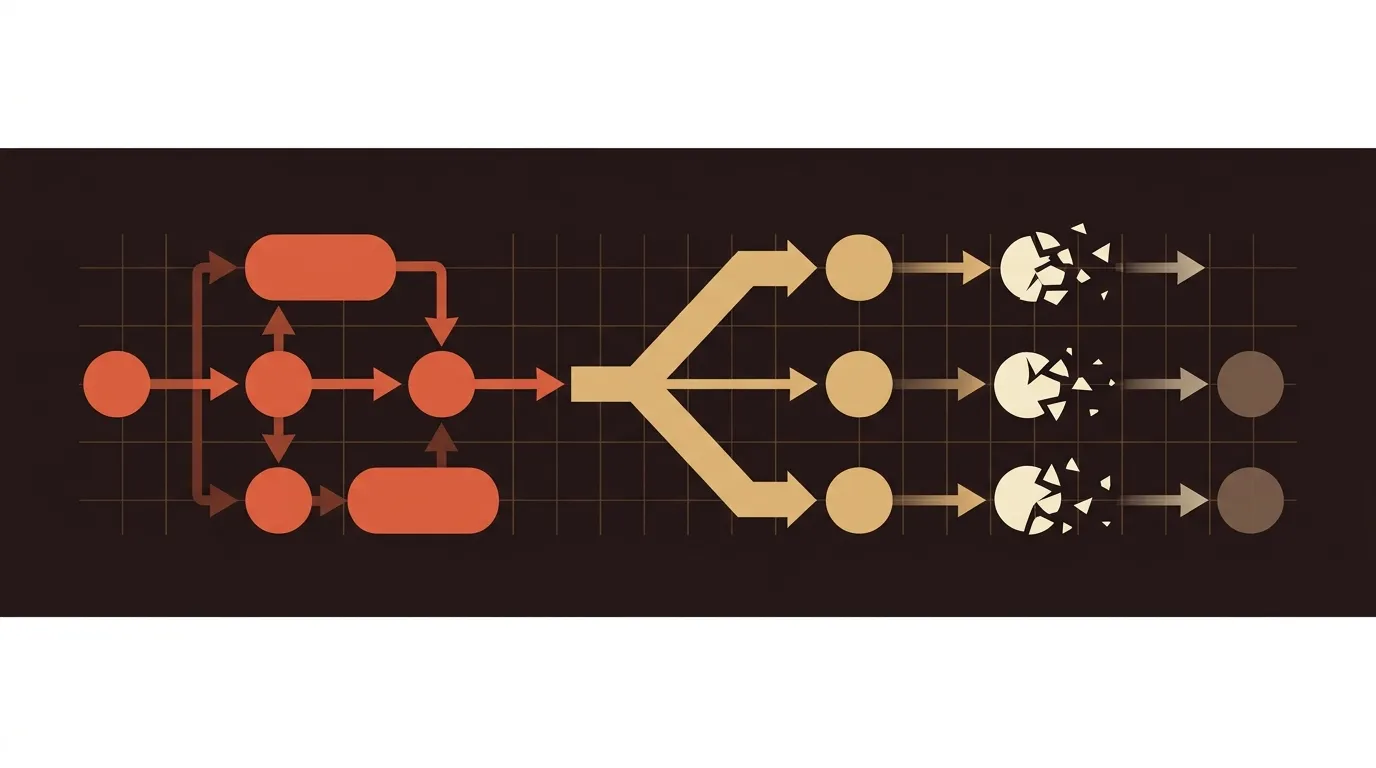

A two-person content team at a B2B SaaS company published 8 articles per month. After redesigning their workflow (same headcount, same tools), they hit 35 articles monthly. The multiplication factor wasn't AI writing. It was everything that happened after the draft existed.
That distinction matters more than most ROI models account for. We've spent years watching teams celebrate the generation speed of AI tools while their content sits unpublished, unlinked, and unindexed for weeks. The cost of that delay isn't abstract. It's compounding revenue you're not earning.
The ROI Model Everyone Uses Is Measuring the Wrong Thing
Most B2B content teams benchmark AI content ROI against cost-per-article. Makes sense on the surface: if a freelancer charges $500 per post and an AI tool costs $29/month for 50 posts, the unit economics look transformative. And they are, on the generation side.
But cost-per-article tells you nothing about time-to-value. A post that costs $0.58 to produce but takes 6 weeks to reach search visibility has a fundamentally different ROI profile than one that ranks in 3 weeks. For B2B SaaS companies with average deal sizes of $15,000-$50,000 and sales cycles of 3-6 months, that timing gap isn't trivial.
Here's what the data actually shows: teams with documented end-to-end workflows see $8.55 return for every $1 spent, roughly 750% ROI. But that figure assumes efficient execution across the full pipeline. Strip out the downstream steps, automate only generation, and the compounding clock doesn't start ticking until weeks later.
The real constraint on AI content ROI in 2025-2026 isn't generation quality. It's the 1-3 month window to first measurable ranking signal, and that window is almost entirely determined by what happens after the draft is written.
Five Downstream Steps That Determine Your Payback Window
Generation is step one. The five steps that follow it determine whether your content starts compounding this quarter or next.
Keyword validation eats 2-4 hours per week as teams bounce between tools checking search volume, difficulty scores, and SERP intent alignment. Topic research and keyword validation remain one of the biggest manual time sinks even for teams that have automated drafting. Getting this wrong doesn't just waste the article; it wastes every downstream minute spent on a post targeting the wrong query.
Quality scoring is where most teams rely on gut instinct or a single editorial pass. Without structured evaluation criteria (readability thresholds, factual accuracy checks, brand voice consistency), bad content gets published and good content gets stuck in revision loops. Both outcomes delay time-to-index.
Internal linking is the silent authority builder. Each new article should connect to your existing content library through contextual links that help search engines understand your site's topical structure. Manual internal linking across a 200-post library is genuinely painful. Most teams skip it or do it inconsistently, which means each new post operates as an island instead of reinforcing the whole corpus.
Metadata and tagging sounds simple but creates persistent friction. Categories, meta descriptions, Open Graph tags, schema markup. Configuring default metadata fields and auto-population rules removes a 15-20 minute task per article that, multiplied across 30+ posts per month, adds up to a full workday.
CMS publishing and indexing is the final bottleneck. Manual content publishing drains valuable hours from marketing teams every week between formatting, scheduling, and verifying that everything renders correctly. And even after publishing, most teams wait passively for search engines to discover the new content rather than triggering immediate indexing notifications.
Each step adds 1-3 hours of manual work per article. Multiply that across 20-50 posts per month and you're looking at 20-150 hours of labor that has nothing to do with writing.
Three Small-Team Configurations, Three Different Payback Timelines
We've modeled time-to-ROI across three common small-team setups. The differences are dramatic.
Configuration A: AI Generation + Fully Manual Downstream
One marketer uses ChatGPT or Jasper to generate drafts, then manually handles keyword validation (Ahrefs or Semrush), editing, internal linking, CMS formatting, and publishing. This is the most common setup we see.
Typical output: 12-15 articles/month Time per article (post-draft): 4-6 hours Time to first ranking signal: 8-12 weeks Monthly labor on downstream steps: 60-90 hours
The bottleneck is obvious. Generation takes 30 minutes. Everything else takes half a workweek per batch. And because publishing happens in bursts (when the marketer finally has time), indexing is inconsistent and ranking signals arrive late.
Configuration B: AI Generation + Partially Automated Downstream
A two-person team uses AI writing tools plus a scheduling tool (like WordPress with Yoast), some internal linking suggestions from a plugin, and basic metadata templates. Keyword research is still manual but batched weekly.
Typical output: 20-25 articles/month Time per article (post-draft): 2-3 hours Time to first ranking signal: 5-7 weeks Monthly labor on downstream steps: 40-75 hours
Better, but the partial automation creates an uneven workflow. Some steps are fast, others remain bottlenecks. Internal linking and quality scoring are usually the weak links here, because plugins offer suggestions but still require human judgment on every decision.
Configuration C: End-to-End Pipeline Automation
A one-to-two person team runs a pipeline that handles research, generation, quality evaluation, SEO optimization, internal linking, metadata, and CMS publishing with minimal manual intervention. Human review happens at defined checkpoints rather than on every micro-task.
Typical output: 35-50 articles/month Time per article (post-draft): 15-30 minutes of review Time to first ranking signal: 3-4 weeks Monthly labor on downstream steps: 10-20 hours
The IndexNow protocol integration is a specific accelerator here. Automatic search engine notifications on every publish event mean content gets discovered days or weeks earlier than traditional crawl-based indexing. That single automation touchpoint can shave 1-3 weeks off the time-to-ranking-signal.
The Compounding Math That Makes Timing Everything
SEO ROI averages 702% over three years. That's a compounding return. Which means the earlier you enter the compounding window, the disproportionately larger your total return.
Let's run the numbers on a specific scenario.
Assume a B2B SaaS company with a $25,000 average contract value, a 2% visitor-to-lead conversion rate, and a 5% lead-to-customer conversion rate. Each organic visitor is worth roughly $25 in pipeline value ($25,000 × 0.02 × 0.05). If a well-optimized blog post attracts 200 organic visitors per month at maturity, that's $5,000/month in pipeline contribution per post.
Now consider the timing difference between Configuration A and Configuration C.
Configuration A's content reaches ranking maturity (page-one visibility for target keywords) at month 4-5 after publication. Configuration C's content reaches the same maturity at month 2-3, thanks to faster indexing, better internal linking authority, and consistent publishing cadence.
That 60-90 day gap means Configuration A's content starts contributing pipeline two months later. For a batch of 15 articles published in Q1, that's 15 posts × $5,000/month × 2 months of delay = $150,000 in deferred pipeline over the life of those articles. Even discounted to the immediate quarter, the deferred pipeline impact runs $8,000-$15,000.
This is not a theoretical number. It's a direct consequence of compounding delays.
Why Partial Automation Actually Adds Strain
Here's something that doesn't get discussed enough: more than half of teams (56%) say implementing generative AI has added strain to their workflows. That's counterintuitive until you look at where the strain lands.
AI generation tools produce drafts fast. Faster than editors can review them. Faster than anyone can validate keywords, build internal links, format for CMS, and publish. So teams end up with a growing queue of "almost done" content that requires more human attention per unit than before.
It's a bit like speeding up the assembly line but keeping the same number of quality inspectors at the end. You don't get more finished products. You get a bigger pile of half-finished ones.
The math is stark. If generation saves 4 hours per article but keyword validation, quality scoring, internal linking, and CMS publishing still consume 6-8 hours manually, you've created a false efficiency. Total labor per published article barely changed. But now you have the expectation of higher output without the infrastructure to deliver it.
Less than 1% of marketing teams have advanced capabilities across the full content creation process. That stat is from 2025. The gap between AI adoption and AI workflow maturity is enormous.
The Four Automation Touchpoints With the Highest ROI Impact
Not every downstream step benefits equally from automation. Based on the time-to-ranking-signal data, four touchpoints deliver disproportionate returns.
Indexing notifications (IndexNow or equivalent API pings) cut discovery time from "whenever Google gets around to it" to near-immediate. For trending or competitive keywords, this can be the difference between ranking and being invisible. Cost to implement: near zero. Impact on time-to-ROI: 1-3 weeks compressed.
Internal linking automation builds topical authority across your content library with every new publish. Automated systems analyze new content against existing articles to identify connection points through keyword matches and semantic relationships. This compounds. A 50-article library with strong internal linking outranks a 200-article library with sparse connections.
Quality evaluation loops that score content against defined criteria before publishing catch issues that would otherwise require post-publish edits (which reset ranking signals). The key is structured scoring, not just "does this read well?" Readability grade, keyword density, factual claim verification, and brand voice alignment all feed into a publish/revise decision.
Metadata auto-population removes the most tedious per-article task. Setting up rules that automatically assign categories based on content type and suggest tags based on article content saves 15-20 minutes per post and ensures consistency across your library. Inconsistent metadata confuses search engines and dilutes topical signals.
What This Means for Your Next Quarter
The window for B2B content teams to establish organic authority is narrowing. AI-generated content volume across the web is increasing (companies using AI produce 42% more content per month), which means competitive SERPs are getting more crowded. Speed to ranking signal is becoming a differentiator in itself.
Teams that have automated generation but left the remaining five steps manual are paying a hidden tax. Not in dollars per article, but in deferred compounding. Every week between "draft complete" and "indexed and ranking" is a week where your competitors' content is accumulating authority and yours isn't.
The fix isn't more writers or better prompts. It's workflow architecture. Small teams with solid end-to-end workflows outproduce much larger teams using ad-hoc methods. A two-person team that publishes 35 optimized, interlinked, immediately-indexed articles per month will outperform a ten-person team publishing 15 manually-processed ones. Every time.
So if your AI content ROI numbers look underwhelming, stop looking at cost-per-article. Start measuring time from draft completion to first organic impression. That's where the money is hiding.
References
- Content Marketing ROI Benchmarks for B2B SaaS (2026 Data) - Averi
- AI Content Creation Workflows: Scale Quality Content & Eliminate the Prompt Bottleneck - NAV43
- AI-powered work management guide - Adobe
- Automate SEO Content Workflow: Complete 2026 Guide - Sight AI
- Automated Content Creation Workflow Guide for Teams - Sight AI