
B2B SaaS content programs average a 702% ROI over three years, according to recent benchmark data from Averi. That number gets quoted in boardrooms, dropped into pitch decks, and used to justify six-figure content budgets. But most small teams never get anywhere close to it. Not because the math is wrong, but because they're measuring the wrong thing at the wrong time.
The typical content program gets killed around month four. And the frustrating part? That decision is perfectly rational given the data available at month four. It's only irrational when you zoom out to the full payback curve.
We've spent years watching this pattern repeat. A team launches a blog, publishes consistently for 90 days, checks the numbers, sees nothing, and pulls the plug. They were three months away from break-even.
The Measurement Window Problem
Cost-per-article is the default metric for evaluating content programs in their first quarter. It makes intuitive sense: you spent $4,000 on an article, it generated 200 sessions, so you paid $20 per session. Terrible. Paid search gets you clicks for $3-8 in most B2B verticals.
But this comparison is structurally flawed. Directive Consulting's analysis of B2B marketing ROI by channel puts it plainly: short-cycle channels like paid search show ROI in weeks, while SEO and content take quarters or years. Measuring SEO ROI over 30 days is like grading a marathon runner at mile three.
Paid search is a rental. You stop paying, the traffic stops. Content is an asset. That article you published in February is still generating sessions in November, and its marginal cost of production has already been paid. The economics are fundamentally different, and cost-per-article at month one tells you almost nothing about portfolio ROI at month twelve.
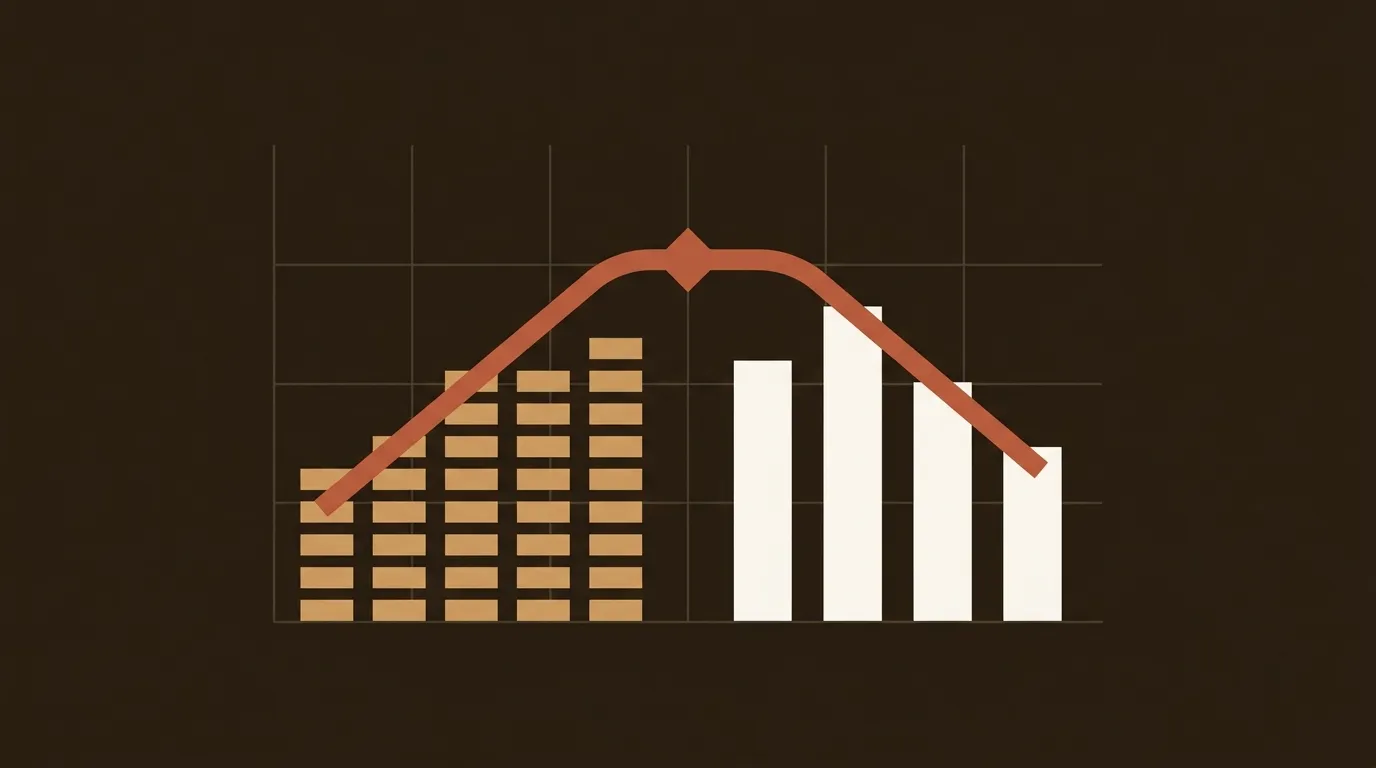
The metric that actually matters is organic sessions-per-dollar over time. And that curve looks terrible early, then inflects, then compounds.
Building the Payback Curve
We've modeled this across enough programs to see a consistent shape. The specific numbers vary (we'll get to the variables), but the curve follows a predictable pattern.
Months 1-3: The investment pit. You're publishing content. Google is indexing it. Almost nobody is reading it. Your cumulative spend is climbing, your organic traffic attribution is flat, and your sessions-per-dollar ratio looks like a rounding error. A team spending $3,000 per article and publishing biweekly has invested $18,000 with maybe 500 organic sessions to show for it. That's $36 per session. Finance is not impressed.
Months 4-6: The slow climb. Some early articles start ranking on page two or three. A few hit page one for long-tail queries. Organic sessions per month tick up from 200 to maybe 800-1,200. Cumulative spend is now $36,000-$54,000 depending on cadence. Sessions-per-dollar is improving but still underwater. This is the danger zone, the window where most programs die.
Month 7: Break-even. Benchmark data suggests B2B SaaS content programs break even around month seven on average. Your older articles are now generating consistent traffic. New articles benefit from improved domain signals. The portfolio effect kicks in: internal links between related posts create topical authority clusters, and Google rewards that. Monthly organic sessions start exceeding the cost of new content production.
Months 8-36: Compounding returns. This is where the 702% number comes from. Content published in month two is still generating sessions in month twenty. Your production costs are linear (you keep publishing), but your traffic growth is exponential. By month 18, most programs generate 3-5x their monthly investment in organic traffic value. By month 36, that ratio reaches 7-10x.
Three Variables That Shift Your Break-Even Date
The month-seven average is just that: an average. Your specific break-even depends on three inputs.
Publishing cadence
More content means more indexed pages, more keyword coverage, and faster topical authority signals. A team publishing four articles per month reaches critical mass earlier than a team publishing one. But there's a quality threshold. Twelve mediocre articles per month won't outperform four strong ones. We've seen teams publishing twice weekly with DA 40+ domains break even by month five. Teams publishing biweekly with the same domain strength tend to hit month eight or nine.
Per-article cost
This one's straightforward. A team spending $5,000 per article needs each piece to generate more value than a team spending $1,500. The break-even math shifts accordingly. If your all-in cost per article (including internal team hours, tools, editing, and distribution) is $2,000, your portfolio needs to generate less total organic value before it turns positive than a program running at $5,000 per piece.
Nearly half of SaaS marketers don't measure content ROI at all, which means they also don't know their real per-article cost. Most teams undercount it. They track the freelancer invoice but forget the 3 hours their marketing manager spent on briefing, editing, and publishing. Honest cost accounting matters here.
Domain authority band
This is the variable people most underestimate. A DA 50 site publishing a well-optimized article on a medium-competition keyword can rank on page one within 6-8 weeks. A DA 15 site targeting the same keyword might wait six months. The difference compounds across every article in your program.
If your domain is below DA 20, your break-even is likely month 10-14, not month 7. That's not a reason to skip content; it's a reason to set expectations correctly and commit to a longer investment horizon.
The Month-Four Trap
So why do teams quit at month four? Because the data at month four supports quitting.
Consider a real scenario: a 2-person marketing team at a SaaS startup (DA 25) launches a content program in January. They publish two articles per week at $2,500 each, all-in. By April, they've spent $40,000. Google Analytics shows 1,800 organic sessions attributed to blog content. That's $22 per session. Their Google Ads campaigns deliver clicks at $6.
The CMO asks a fair question: why are we spending $10,000 a month on something that costs 3.5x more per session than paid search?
And the honest answer is: because by October, those articles will be generating sessions for free, and by next April, the program will have paid for itself twice over. But that requires faith in a model that most teams haven't built.
The Growth Terminal's analysis of B2B content ROI identifies this exact pattern: companies invest heavily in creation, then measure success through pageviews rather than pipeline, and pull the plug before compounding takes hold.
The month-four decision isn't irrational. It's rational behavior based on an incomplete measurement window. Fix the window, and the decision changes.
What a Full-Lifecycle Model Should Look Like
Stop measuring individual articles. Start measuring portfolio economics.
A proper content economics model tracks four things over rolling 12-month periods.
Cumulative organic sessions attributed to the content portfolio. Not just new articles. Every article ever published that's still generating traffic. This is the compounding engine. B2B ContentOS makes this point well: the formula (Revenue Generated minus Total Investment, divided by Total Investment, times 100) only works if "total investment" includes the full history, and "revenue generated" includes the long tail.
Blended cost-per-session over time. Divide your total lifetime content spend by total lifetime organic sessions. This number should decrease every month once you pass break-even, because old content keeps generating sessions at zero marginal cost. If your blended cost-per-session isn't dropping by month eight, you have a content quality or keyword targeting problem.
Pipeline influence from organic content. This is genuinely messy. Last-click attribution gives content almost no credit because blog readers rarely convert on the same session. Multi-touch attribution spreads credit more fairly, but can dilute accountability if you're not careful. The best teams we've worked with run both models and compare them. The truth is somewhere in between, and pretending otherwise is just optimizing for a cleaner spreadsheet.
Revenue-per-dollar-invested on a trailing basis. Not monthly. Trailing 6-month or 12-month. This is the number that should go in board decks. A content program that costs $120,000 per year and generates $500,000 in pipeline-attributed revenue over the same period is running at roughly 4:1 returns. That's before the compounding effect of year two, when those same articles keep working without additional production cost.
The Compounding Math That Changes Everything
Here's a specific calculation to make this concrete.
Assume you publish 8 articles per month at a blended cost of $2,000 each. Monthly content spend: $16,000. After 12 months, you've invested $192,000 and published 96 articles.
If each article averages 150 organic sessions per month once it reaches maturity (around month 4-6 after publication), your portfolio generates roughly 10,000-14,000 organic sessions per month by month 12. At a conservative organic traffic value of $4 per session (based on equivalent CPC in your vertical), that's $40,000-$56,000 in monthly traffic value. Against $16,000 in monthly spend.
But here's the kicker: in year two, you keep publishing, and those 96 articles from year one keep generating traffic. By month 24, your portfolio is 192 articles. Even if some older pieces decay, the majority continue contributing. Your cumulative traffic value begins outpacing cumulative investment by a wide and growing margin.
This is where the 702% three-year ROI benchmark comes from. Not from any single article performing extraordinarily well. From the portfolio compounding while marginal costs stay flat.
What This Means for Small Teams Running on Tight Budgets
If you're a 2-person marketing team with a $5,000 monthly content budget, you aren't going to publish 8 articles a month at $2,000 each. Your curve looks different. Maybe you publish 4-6 articles per month at lower cost (using AI tools, in-house writing, or a mix). Your break-even shifts to month 9-12 instead of month 7.
That's fine. The curve still works. It just stretches.
What kills small-team programs isn't the longer timeline. It's the pressure to show results on a quarterly cadence that doesn't match content's natural payback period. If your leadership reviews marketing spend every 90 days and expects positive ROI within each window, content will never survive.
The fix is simple in theory, hard in practice: get agreement upfront on a 12-month measurement window. Show the payback curve model before you start. Set expectations for what month-three numbers will look like (bad) and what month-nine numbers should look like (better). Track against the curve, not against quarterly benchmarks designed for paid channels.
The Honest Part
None of this guarantees success. A content program with weak keyword targeting, thin articles, or no distribution plan won't hit these benchmarks regardless of time horizon. And some verticals are so competitive that a DA-20 site has almost no chance of ranking for commercial terms within 12 months.
We're also not pretending the 702% number applies uniformly. Some programs reach 844% or higher; many settle in the 300-500% range. The difference comes down to distribution maturity and whether teams map content to actual funnel stages or just publish and hope.
The payback curve model doesn't remove risk. It just ensures you're measuring correctly so you can make informed decisions about that risk. A team that quits at month four because the curve looks bad is making a data-driven choice with incomplete data. A team that quits at month ten because the curve still looks bad is making a genuinely informed one.
Those are very different decisions, even if they look the same from the outside.