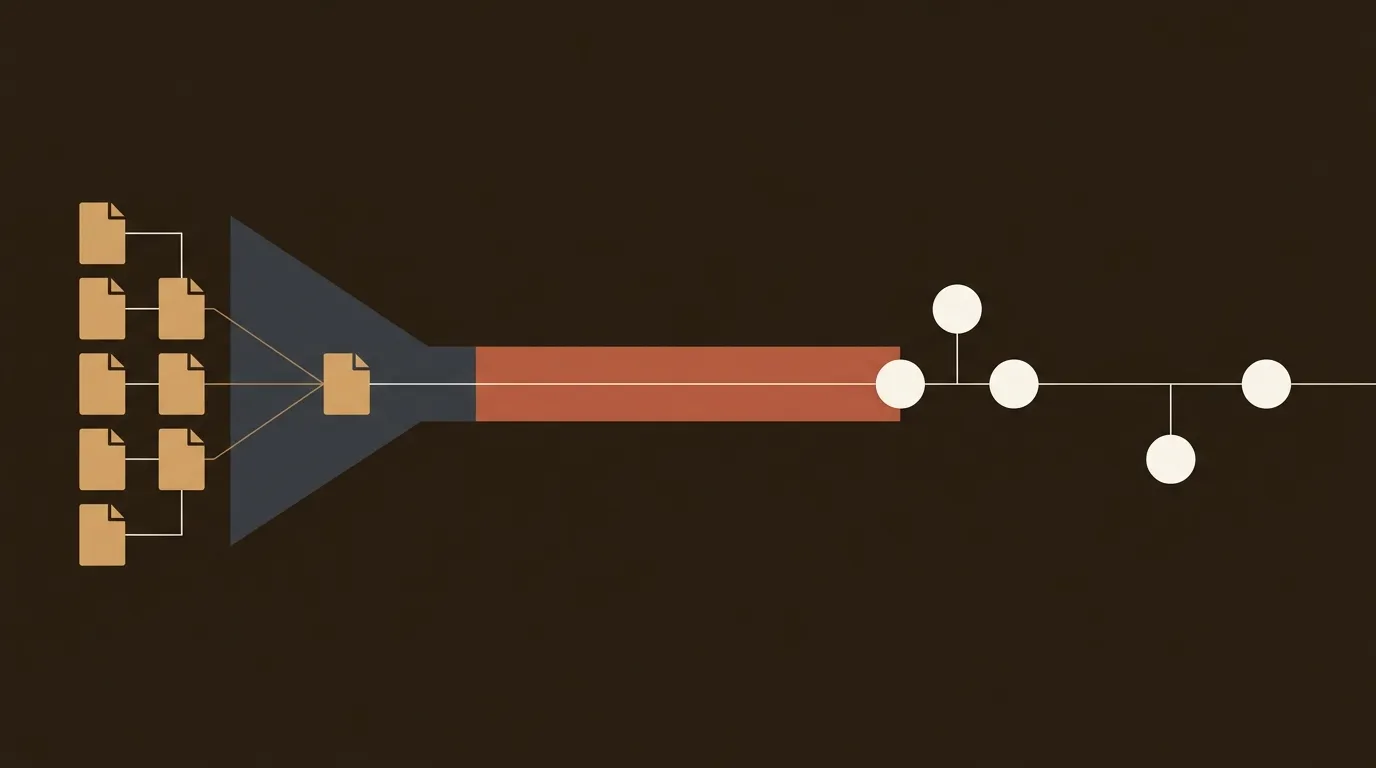
Most B2B content teams publish 30, 50, even 100 posts a year and still can't crack page one for their primary topics. The assumption has always been that volume eventually compounds into authority. Google's March 2026 core update proved that assumption wrong, and the data is now clear enough to build a scoring model around what actually works.
The update finished rolling out after 12 days and 4 hours, and within two weeks, 55% of tracked sites across Ahrefs and Semrush datasets registered measurable ranking changes. Sites on the wrong side lost 20-35% of organic traffic. Some lost more than 50%. The pattern wasn't random. Sites with scattered content across unrelated topics got hit hardest. Sites with deep, interlinked coverage of focused subject areas held or gained.
That's the shift. Topical authority isn't a byproduct of how much you publish. It's a function of how your content is architecturally connected.
Volume Isn't Depth, and Google Finally Made That Official
For years, the SEO playbook was straightforward: find keywords, write posts, build links. If you published enough, you'd eventually rank for adjacent terms. And it worked, mostly, because Google's ranking systems weren't sophisticated enough to distinguish between a site that covered a topic thoroughly and one that just mentioned it a lot.
The March 2026 update changed the weighting. Google now evaluates sites at the domain level for topical authority, assessing how deeply a domain covers its claimed subject areas rather than scoring pages in isolation. A site covering 10 unrelated topics shallowly gets treated differently from one covering 2 topics with genuine depth.
The signals Google re-weighted cluster around three dimensions: information originality (does the content contain something that exists nowhere else), author expertise (verifiable track record in the subject), and topical coherence (consistent authority within a defined area over time). That last one is the architectural signal. It's not just about what you say. It's about how your content relates to itself.
HubSpot's blog reportedly lost an estimated 70-80% of organic traffic. They'd spent years publishing across every imaginable marketing topic, many outside their core expertise. That strategy, which looked brilliant in 2022, became a liability in 2026.
What Cluster Architecture Actually Means (Beyond the Buzzword)
The pillar and cluster model has been discussed since at least 2017, but most teams implement it badly. They create a pillar page, link a few related posts to it, and call it done. That's not architecture. That's decoration.
Real cluster architecture has three measurable properties.
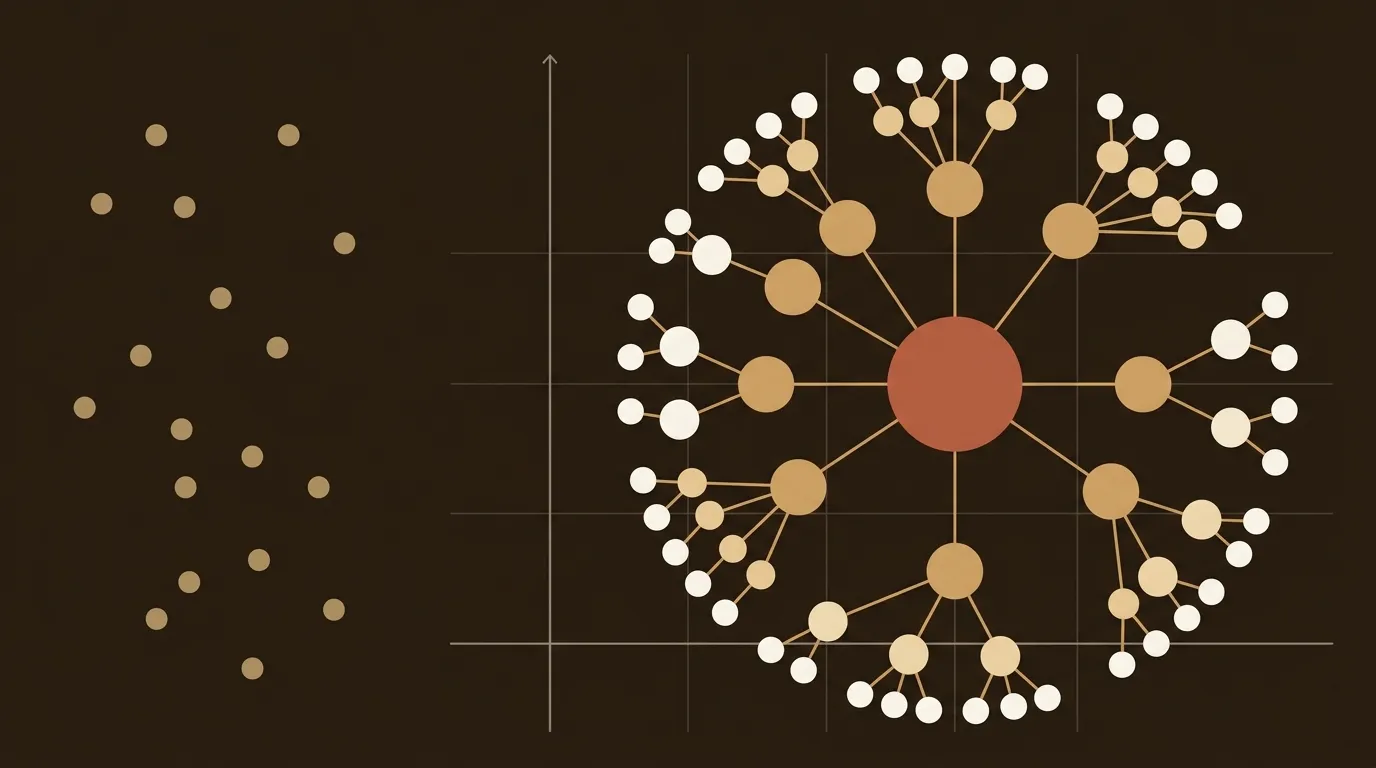
Cluster depth refers to how many distinct sub-questions you've answered within a single topical domain. A site with 20 interconnected articles on email marketing consistently outranks a site with one 5,000-word guide, even if the single article is technically superior. Content clusters increase organic traffic by approximately 40% through this compounding effect, according to industry benchmarks.
Internal link density is the connective tissue. Every cluster page needs to link back to the pillar using anchor text that includes the pillar's target keyword, and the pillar must link out to each cluster page. But it goes further: cluster pages should link to each other where the relationship is genuine. The clearer these relationships, the stronger the authority signal Google picks up during crawling.
Sub-topic coverage is where most teams have blind spots. Selecting a pillar topic requires identifying a broad entity that can be deconstructed into 15 to 30 distinct subtopics. If you've only covered 8 of those 25 sub-topics, you have a cluster with holes. Google sees those holes. So do your competitors.
A Concrete Scoring Model for Small Teams
We've seen teams struggle with topical authority because the concept feels abstract. So here's a scoring framework that makes it measurable. No fancy tools required; a spreadsheet works fine.
Step 1: Define your topical domains. Pick the 2-3 subject areas that directly align with your product or service. Not "marketing" (too broad). Think "B2B email deliverability" or "API security for SaaS platforms." Each domain becomes a cluster to score.
Step 2: Map sub-topics. For each domain, list every meaningful sub-question a buyer or practitioner would ask. Use Google's "People Also Ask," your sales team's most common objections, competitor content audits, and forum threads. Aim for 15-30 sub-topics per domain. This list is your coverage map.
Step 3: Score current coverage. For each sub-topic, check whether you have a published post that substantively addresses it. Not a passing mention in a paragraph. A dedicated piece. Score each domain as a percentage: 12 out of 25 sub-topics covered equals 48% coverage.
Step 4: Measure internal link density. Count the internal links between posts within each cluster. Divide by the number of possible connections (posts multiplied by posts minus one). A 10-post cluster has 90 possible directional links. If you have 15, your link density is about 17%. We've found clusters need at least 30% density before the compounding effect kicks in.
Step 5: Identify your "one post away" clusters. This is where it gets interesting. If a cluster sits at 65-75% sub-topic coverage with decent link density, it's close to what we call ranking dominance. One or two targeted posts filling specific gaps will often unlock traffic gains not just for the new posts, but across the entire cluster.
The math here is worth spelling out. Say you have a cluster of 12 posts averaging 200 organic visits per month each. That's 2,400 monthly visits. Adding 2 gap-filling posts (bringing coverage to 80%+) and tightening internal links often lifts the entire cluster by 30-40%. That's not 400 new visits from the new posts. That's 720-960 additional visits spread across all 14 posts. Compounding, not linear.
Why "Close to Dominance" Matters More Than "Starting Fresh"
Small teams always ask us where to start. The instinct is to begin a brand-new cluster on a topic they've never covered. That's almost always wrong.
Starting a new cluster from zero means you need 15+ posts before Google has enough signal to recognize your authority. At one post per week, that's four months before any compounding happens. And four months is optimistic; content clusters typically need 12+ months of sustained publishing to show their full traffic advantage.
But if you already have a cluster at 60% coverage, you're looking at 4-6 posts to cross the threshold. Two months. And the existing posts in that cluster have already accumulated backlinks, social signals, and crawl history. New content inherits some of that authority through internal links the moment it's published.
One team we studied rolled out a focused cluster completion strategy, filling identified gaps and strengthening internal links across their existing content. The result: a 53% lift in cluster traffic within three weeks, with most support posts up triple digits in views. That's not an anomaly. It's what happens when you complete a pattern Google was already trying to recognize.
The AI Search Angle Nobody's Talking About Enough
Google's AI Overviews and AI Mode are changing how content gets surfaced. And the selection logic for AI-generated answers mirrors the topical authority model almost exactly.
Both Google and AI answer engines select sources at the topic level, not the keyword level. That distinction matters enormously. A single well-optimized post on a domain with no other related content rarely gets pulled into AI Overviews. But a post on a domain that Google already trusts for that entire subject area? That's a different story.
Original, authoritative content demonstrating genuine expertise is more likely to appear in AI Overviews, while thin, summarized content is being excluded. This creates a feedback loop: strong topical authority earns AI citations, which drive brand visibility, which drives clicks (even if the click-through rate per query is lower than traditional results), which reinforces the authority signal.
For B2B teams specifically, this means cluster architecture isn't just an SEO play. It's a visibility play for the AI-mediated search experience that's rapidly becoming the default.
What Recovery Looks Like (and How Long It Takes)
If your site got hit by the March 2026 update, the path forward isn't mysterious. But it is slow.
Expect 4-8 weeks before initial signals appear in Search Console after implementing structural changes. Full recovery often requires the next core update cycle to fully recognize improvements. That could be another quarter.
The work itself involves three phases: pruning content that dilutes your topical focus (yes, sometimes deleting posts improves your domain), completing existing clusters by filling sub-topic gaps, and retrofitting internal links between related posts that were published without any connecting structure.
That last phase, the retroactive linking, is often the highest-ROI activity. We've seen teams add 40-60 internal links across an existing 30-post cluster in a single afternoon and measure ranking improvements within two crawl cycles. No new content required.
The Uncomfortable Part
Here's what makes this genuinely messy for small teams: the scoring model tells you what to do, but it doesn't solve the bandwidth problem. A 2-person marketing team that identifies 8 gap-filling posts across 3 clusters still needs to produce those 8 posts. And they need to be good, not just present. Google's originality signal means thin, generic gap-fillers won't trigger the compounding effect.
We don't have a clean answer for that tension. Automation helps with parts of the production pipeline. So does prioritization, focusing on the cluster closest to dominance rather than trying to complete all three simultaneously. But the constraint is real, and pretending otherwise would be dishonest.
What we can say is that the old model, publishing broadly and hoping volume creates authority, is now actively penalized. The new model rewards focus and architecture. Even at small scale, a team that publishes 4 targeted posts into a nearly-complete cluster will outperform a team that publishes 20 scattered posts across unrelated topics.
The question for most B2B content operations isn't whether cluster architecture works. The March 2026 data settled that debate. The question is whether you can resist the temptation to chase keywords and instead do the structural work that makes every future post more valuable than the last one.
References
- Google March 2026 Core Update Complete: What Changed & How to Recover Rankings - Orange Monke
- Google March 2026 core update rollout is now complete - Search Engine Land
- Better SEO and Visibility with the Pillar and Cluster Content Strategy - Siteimprove
- The complete guide to topic clusters and pillar pages for SEO - Search Engine Land
- Why Building Topical Authority is the Valuable SEO Asset - 6S Marketers